




Does Najib have the infantry to see him through?
COMMENT If it’s true, as former British Labour Prime Minister Harold Wilson observed, that a week is a long time in politics, what more a year?
In less than a year, a gulf in confidence has opened up as seen in the changed tone of pronouncements made by Prime Minister Najib Razak in Singapore.
In a visit to the island republic less than a year ago, Najib was bullish enough about the outlook to say that he was the “biggest warlord” of them all when asked by the press about how his reform drive would fare against the reactionary warlords in Umno...
COMMENT If it’s true, as former British Labour Prime Minister Harold Wilson observed, that a week is a long time in politics, what more a year?
In less than a year, a gulf in confidence has opened up as seen in the changed tone of pronouncements made by Prime Minister Najib Razak in Singapore.
In a visit to the island republic less than a year ago, Najib was bullish enough about the outlook to say that he was the “biggest warlord” of them all when asked by the press about how his reform drive would fare against the reactionary warlords in Umno.
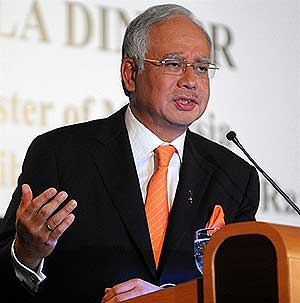 Last Tuesday, at a foreign correspondents’ club dinner in Singapore, Umno’s point man was distinctly less brash.
He said his head was on the chopping block on account of his intended reforms.
He admitted that his determination to purge rent-seeking and patronage politics would pit him against vested interests in the party and in business bent on baulking his reforms.
In other words, Umno’s No 1 warlord was less confident about his reform’s prospects against Malaysia’s politically-connected plutocrats.
A near defeat of his Budget in Parliament last December and the disclosure of the theft of fighter aircraft engines - a scam that took place in 2007 on Najib’s watch as defence minister - all had the odour of a jockeying for advantage in Umno, unsettling to Najib.
Thus a newly vulnerable head honcho is now less certain of his power to steer the ship of state into reformist straits.
Pronouncements by national leaders before foreign correspondents’ clubs are parsed for their statesman value.
His or her vision of the future, courage and candor in defining it, and analytical acuity in delineating the obstacles, are all on display for the interested world’s press to see.
That is why a national leader tries to be at his best before this august body because it is there he or she makes a play for the support of international opinion. That support is related to investment prospects for the country.
Hence the significance of the state-of-the-nation speech of a leader invited to address the foreign correspondents’ club in an international crossroads like Singapore.
Forces of reaction
Najib did well to announce that he had set his administration’s heart against rent-seeking and patronage politics - the two cankers in the Malaysian body politic.
But Najib’s professed aim and determination in seeing his reform drive through presupposes that he has the infantry to carry it to term.
Telltale signs of diffidence before the foreign correspondents’ club and candid allusion to the forces of reaction, not just lying in wait but ready to connive with opportunists in his party playing fast and loose with oscillations in the political pendulum, suggest that he faces a gulf – in the party, in the civil service, and among politically-connected plutocrats – that he has to conjure away or beguile into supporting him.
Alternatively, he could appeal over these reactionary interests to the country at large.
That would require his going to an early general election to obtain popular endorsement which can come only if he succeeds, between now and the time of the hastened poll, in carrying out more than a modicum of his reform agenda.
And nowhere in his announced agenda is there mention of such things as a restored judiciary, without which no true reform of the Malaysian body politic can endure.
Suffice the gulf that Najib has to traverse for his reform drive to succeed is a lot more daunting than which he described before the foreign correspondents’ club in Singapore.
TERENCE NETTO has been a journalist for close on four decades. He likes the occupation because it puts him in contact with the eminent without being under the necessity to admire them.


