




Indonesian worker exodus worries Sabah planters
A steady exodus of Indonesian workers from the palm oil industry in Sabah for better wages back home has local planters increasingly worried.
A steady exodus of Indonesian workers from the palm oil industry in Sabah for better wages back home has local planters increasingly worried.
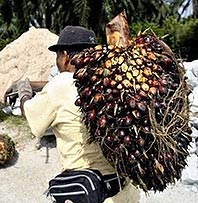 Indonesian workers are reportedly also fed up with deductions for passports, permits and levies, besides being saddled with low wages, and suffering harassment at the hands of the immigration, police, other government officials and a bad press.
They are also not allowed to be accompanied by their families, and those who enter illegally live in constant fear of being deported.
The exodus is an ironic turn of events in a state long wrestling with thousands of illegal immigrants and dependent on foreign labour.
“The oil palm sector must consider hiring and training more locals,” acknowledges Federal Plantation Industries and Commodities Minister Bernard Dompok.
“It is becoming more difficult to get foreign workers who form the majority in the palm oil sector in Sabah.”
He was speaking at the sidelines of a meeting in Kota Kinabalu on Monday on such issues as productivity and sustainability in the palm oil sector.
Many of the issues, especially on labour, were that previously raised by the East Malaysia Planters Association (Empa) with the government.
Change of mindset required
 The oil palm industry has to change its mindset and shift to a new paradigm as foreign labour will be increasingly scarce and costly, said Dompok (
left)
.
The oil palm industry has to change its mindset and shift to a new paradigm as foreign labour will be increasingly scarce and costly, said Dompok (
left)
.
He urged plantation owners not to just concentrate on profits but also provide more facilities to attract workers.
“This is in line with the growing involvement of plantation companies in discharging their Corporate Social Responsibility activities, in tandem with the government’s efforts to improve the welfare of palm oil workers. “
In the long term, the move is expected to attract a bigger pool of local workforce.
The government hopes this will help reduce dependency on foreign labour in the plantation sector.
“So, I strongly urge all industry players to enhance their CSR and make available more funds to improve the infrastructure for workers in the estates,” said Dompok. “This includes housing, medical and schooling facilities.”
Labour situation
Already, the labour situation is expected to worsen even further as East Kalimantan alone plans to open up five million hectares for oil palm.
It is paying significantly more than Sabah plantations to lure its workers back home to the one million hectares already under development.
Dompok sees the need for plantations in Sabah to increase both their acreage and yield as productivity is stagnating.
However, with a mechanical cutter called Cantas to harvest Fresh Fruit Bunches (FFB), a harvester can cover an area of 50 hectares compared to 21 hectares with a sickle.
“If the Cantas is used, the industry would only need 40, 540 harvesters compared with the 96, 525 harvesters needed using the manual sickle method,” said Dompok.
Indonesian worker exodus
Harvesters form the biggest percentage of the Indonesian worker exodus from Sabah oil palm plantations . It is estimated that harvesters form 35 per cent, or 176,795 of the foreign workers in the sector.
The Malaysian Palm Oil Board (MPOB) reckons that there are 376, 906 foreign workers in the oil palm sector or 75 per cent of the total work force.
“Given the scenario of increasing competition in the global oils and fats market, the palm oil industry needs to explore all available means to enhance productivity and its competitiveness,” worries Dompok.
This, he reiterated, called for new strategies to make changes where necessary in order to remain competitive and cope with the emerging threat from Kalimantan.
The irony is that Malaysian companies are in the forefront of developing the palm oil industry in Kalimantan, according to the MPOB.
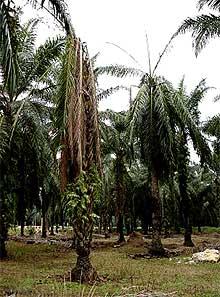 For example, a GLC like Fima alone has 14,000 hectares under oil palm in East Kalimantan. PT Dermaga Perkasapratama, run by Malaysian executives, plans to venture into oil palm cultivation after having been in coal, oil and gas since 1974.
Another three Malaysian companies are developing 60,000 hectares, according to MPOB figures. The target is to have another 400,000 hectares soon under oil palm in addition to the present 600,000 hectares.
In South Kalimantan, there are seven Malaysian plantation companies and Governor Rudy Ariffin has embarked on a drive to woo even more to invest in his province. Here the wages are said to be much higher than in Sabah.
Sabah currently has the largest planted acreage under oil palm in Malaysia - 1.36 million hectares or 29 percent of the nation’s total acreage.
This pales in comparison with Kalimantan’s reported target of boosting that acreage by two million hectares a year. Elsewhere, there are plans to set up palm oil industrial clusters as in Lahad Datu.


