




Umno and its red herrings
'All things are wearisome, more than one can say... What has been will be again, what has been done will be done again; there is nothing new under the sun.' (The Ecclesiastes)
Barry Wain, a former editor at the Asia Wall Street , relates in his latest book Malaysian Maverick: Mahathir Mohamad in Turbulent Times how the authoritarian leader found himself with his back against the wall in the wake of the series of financial scandals involving the then Bank Bumiputra in the mid 1980s.
'All things are wearisome, more than one can say... What has been will be again, what has been done will be done again; there is nothing new under the sun'. (The Ecclesiastes)
Barry Wain, a former editor at the Asia Wall Street , relates in his latest book Malaysian Maverick: Mahathir Mohamad in Turbulent Times how the authoritarian leader found himself with his back against the wall in the wake of the series of financial scandals involving the then Bank Bumiputra in the mid 1980s.
Losing his cool, the former prime minister in a speech at the 1986 Umno General Assembly asked the audience, ‘Why is there only a fuss about Bank Bumiputra? Because it is a scandal, or because it is bumiputera ?’
 He also went on to question as to why the “scandal-mongers” from the opposition parties did not bother to mention Singapore’s Pan-Electric Industries Ltd.(Pan-EI), the collapse of which momentarily brought the stock exchanges of both Singapore and Malaysia to their knees.
One of the chief culprits behind Pan-EI’s demise was none other than Tan Koon Swan, then president of the Malaysian Chinese Association. True to form, Mahathir posed a question that reeked – as Anwar Ibrahim describes it - of “subtle racist innuendos”, ‘Could it be because it was not committed by bumiputera ?’
Ever so cunning, Mahathir sought to confuse and delude the public by lumping the state-owned, loss-ridden Bank Bumiputra with the private-run Pan-EI in an attempt to absolve himself of any responsibility, a bizarre comparison that is categorically rebutted by Wain in the book.
While more than two decades have passed, revisiting this chapter of history nevertheless gives rise to the surreal feelings that the passage of time has failed to chart a new course for Malaysian politics.
The poisonous trick
Although Umno in the mid 1980s was not confronted with a formidable opposition alliance as it is nowadays, the split of the party into two equally powerful camps commanding mass followings clearly put Mahathir’s job as president on the line.
Even a slightest strategic error could have far-reaching consequences, and the tough guy’s political future could not have been more uncertain.
When Mahathir defeated Razaleigh in the April 1987 party election by a razor-thin majority, the party was beyond repair.
The Bank Bumiputra scandal snowballed unabated and with the judiciary hit with one crisis after another, Mahathir was compelled to resort to the poisonous trick that he knew (and still knows) best: raising ethnic tensions at all costs.
Thanks to the supporting roles played by Anwar, then holding the
 education portfolio, Lee Kim Sai, the MCA deputy president, and the acting Umno Youth chief Najib Abdul Razak, Mahathir succeeded in creating a climate of fear that ‘justified’ his use of the infamous Internal Security Act, sending his political foes – real or imagined – to detention camps.
It gave him a reprieve that he badly needed and signalled the turnaround in his political fortunes thereafter.
A pre-Operasi Lalang classic performance of Najib ought to be his appearance at a rally held in Kampung Baru, a Malay heartland of Kuala Lumpur, where he warned the Chinese not to test the limits of Malay generosity and tolerance.
It has since become a blemish on his political record, but pales into insignificance compared to the stench of scandals that he has brought with him in recent years.
Following the High Court’s ruling last week on the use of the term Allah by non-Muslims, ethnic tensions in the country seem to have been heightened again.
Umno had hoped to exploit the issue to drive a wedge between Pakatan Rakyat leaders, but Pas’ political bureau surprised many by choosing to back the court ruling, quite to the dismay of Prime Minister Najib and the likes.
Playing to the gallery
Looking back at Umno’s history, upping the ante to preserve its own political dominance has long been a tradition. As a matter of course, Umno-controlled media has been playing up the issue, even referring to church-burning incidents in India with a view to striking fears into the intended recipients of the strong message.
All this is happening with the connivance of the prime minister, prompting the mild Father Lawrence Andrew, the editor of The Herald, the very Catholic weekly at the centre of the controversy, to opine it is meant to “create a climate of fear and a perceived threat to national security so as to pressure the court in reversing its decision”.
Having failed to divide the Pakatan partners, while the Catholic and moderate Muslim groups keep calm, Najib appears to have opted to play to the gallery, conceding his ‘inability’ to stop the masses from congregating in mosques to express their objection to the court ruling.
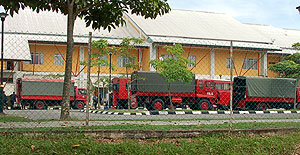
Would one honestly believe the prime minister is powerless to halt the planned protests? Then how is Najib to explain why his government was swift and efficient in locking down the entire city centre of Kuala Lumpur just to preempt the anti-ISA rally on 1 August last year, practically turning the capital into a battlegro
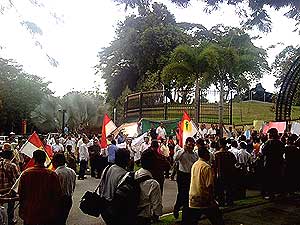 und with tear gas and water cannon?
The truth is, Najib has given in to forces hostile to judicial interpretation on religious matters because they could be conducive to aggravating the siege mentality of the Malay community, shoring up support for Umno, and diverting the public’s attention away from the hot issues.
The opposition parties, bogged down by the controversy and struggling to respond, will likely not be able to concentrate on the more important and substantive public issues. These, includes the investigations into the tragic death of Teoh Beng Hock, the Port Klang Free Zone debacle and the mysterious disappearance of Royal Malaysia Air Force jet engines.
In a proper democracy, any of these issues will be explosive enough to topple the government.
Here in Malaysia, a kleptocracy par excellence, the Barisan Nasional has been able to turn crises into blessings, no thanks to the hosts of draconian laws and the ever-subservient state apparatus.
Still not enough? Just fan up racial/religious sentiments to distract the enemy, and the boat would sail to a safe landing in no time amidst the roaring noise.
Disgruntled at the ruling
Because Malaysians have lived for many years in constant fear of the omnipotent state, news of protests and rally can easily send chills down our spine. It ought not to be so.
We may criticize the prime minister for exercising double standard, but we must not emulate Lau Weng San, the DAP representative for Kampung Tunku, who has questioned as to why no action was taken against those who protested against the High Court decision.
A short-sighted, narrow-minded and inconsistent politician as such is the last thing we deserve.
Instead of calling for a ban on the planned gatherings, we should
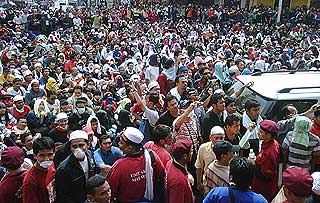 learn to respect Muslim Malaysians’ right to freedom of assembly, while reminding the government to honour our democratic rights also.
I am all for peaceful assembly by Muslims who genuinely feel disgruntled at the ruling on the use of Allah by others, and the police is duty-bound to ensure no untoward incidents may occur.
Still, we must press on with finding out the whys and wherefores behind all the scandals and fiascos, and be adamant that Najib and his administration be forthright and transparent in their handlings.
Malaysia’s existent political climate is not entirely dissimilar from that of the 1980s, and one does feel history is repeating itself again.
In those eventful days, Mahathir managed to save his skin by duplicity and dirty tricks, and secured for himself another decade and a half of exponential corruption and mismanagement.
Have we really learned the heavy lesson, or would we allow ourselves to be distracted by all the red herrings again, which could eventually benefit Najib and his cohorts?
JOSH HONG studied politics at London Metropolitan University and the School of Oriental and African Studies, University of London. A keen watcher of domestic and international politics, he longs for a day when Malaysians will learn and master the art of self-mockery, and enjoy life to the full in spite of politicians


