




Malaysia's Vision 2020 cataract possible
The much vaunted Vision 2020 for Malaysia to achieve developed status may miss the target by about a decade for not learning from past economic crises.
The much vaunted Vision 2020 for Malaysia to achieve developed status may miss the target by about a decade for not learning from past economic crises.
 On top of that, she has also failed to draw lessons from her own success and failures.
This is clear from the continuous push for financial liberalisation by very strong lobbyists who protect the interest of elite few in the financial market.
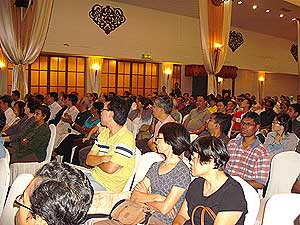
This criticism came from United Nations assistant secretary general for economic development Jomo Kwame Sundram when addressing an audience of around 200 in Petaling Jaya last night.
His lecture was entitled ‘When will we ever learn? Has Malaysia learnt correct lessons from past crises?’
He dismissed the notion that financial liberalisation had contributed to economic growth.
Palm oil the saviour
"Malaysia's economic growth during the boom period was due to palm oil not financial liberalisation.
"Though palm oil could not penetrate Western markets, it did penetrate other markets such as China, India and the Middle East,” he said.
 Jomo, who was professor of applied economics at University Malaya before his current appointment, also said that it was unfortunate that members of parliament too were unaware of this as they had superficial understanding of the success and failures.
Instead many harboured vague ideas about free trade zones.
Malaysia, just as the rest of the countries in the Southeast Asian region, failed to identify the major differences among the economies of Northeast Asia and Southeast Asia.
"Northeast Asian countries were enjoying growth of eight percent in the early 1990s whereas Malaysia and its neighbours had six percent,” he said.
There was also a higher degree of inequality between the rich and the poor in South East Asia.
The region also tended to reduce social spending but Malaysia did expand a lot on the health sector resulting in a drop in mortalities.
Financial liberalisation a failure
In the post Asian financial crisis of 1997, Jomo said it was again proven that financial liberalisation failed to bring about development.
Instead, it bled out the capital resources of Third World countries. "Half of the capital inflows in the year 2007 went to the US due to financial liberalisation.”
 Jomo also commented on the capital control implemented by former prime minister Dr Mahathir Mohamad as a good move that came 14 months late.
He also praised the former premier for restoring economic growth.
In explaining the evils of financial liberalisation, Jomo quoted the late James Puthucheary who likened 'financial liberalisation to opening a bird cage and expecting birds to fly in'.
On the international economy, Jomo touched on the failure of international economic reforms which have been without any system since the collapse of the Bretton Woods agreement.
Bretton Woods was a financial system created to rebuild international economies after World War II and subsequently collapsed in 1971 when the United States took unilateral steps to make the US dollar the reserve currency replacing gold.
Jomo proposed the establishment of Special Drawing Rights (SDR) instead of the current reliance on the US dollar. SDR, according to him, is a better option as it will boost equity in the market with new investments during a crisis.
SDR are free international reserve assets from the International Monetary Fund.
The lecture was jointly organised by local publisher, Gerak Budaya and the organisation, Youth 4 Change.


