




BTN, Umno and the changing Malay world
When the politics of race dominates the political scene in a multi-racial society, racial unity has always been the rallying cry for political parties; the assumption is that once all members of a race are united under one political party, the race then enjoys greater leverage in inter-racial negotiation for more interests and rights.
When the politics of race dominates the political scene in a multi-racial society, racial unity has always been the rallying cry for political parties; the assumption is that once all members of a race are united under one political party, the race then enjoys greater leverage in inter-racial negotiation for more interests and rights.
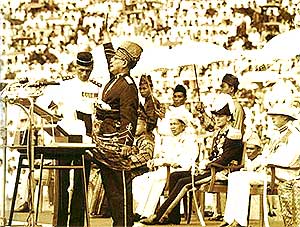 Since most of the political parties in Malaysia have been race based from the very early days, and Umno's perennial success at the polls and within the ruling coalition has enabled many race-based nation building politics to dominate our national life, most commentators and academics authoring books on Malaysian politics have always condemned Malaysian politics to be communal in nature.
I, like a small handful of political activists and commentators have always argued against this position since the early days of the 1970s.
We did and still do so not out of a sense of idealistic naiveté, but out of deep thought in the study of history and political science.
If you observe and study history and current affairs with the assumption that you must accept "reality", then indeed the politics of race must forever dominate Malaysian politics.
On the other hand, if you analyse politics from the position of seeking the patterns and agents of change, using any number of kits from out intellectual tool box - including Hegel's idea of historical dialectic - then you will always be on the look out for the fulcrum upon which fundamental radical structural change in our political life can evolve.
In short, looking for possibilities and options in historical change is always the way towards emancipation from the stultifying self-enslaving and defeatist ideology of political realism.
What you sow not nessarily what you reap
Political actors always have their fixed goals and their national agenda in mind.
What they cannot always foresee is the result of the unintended consequences of their plans and actions.
What we need to do is to grope around in the uncertain waters of unintended consequences in advance.
In the early years of the communal life of the Malay community in Malaysia, the Malays were a more or less homogenous ethnic community.
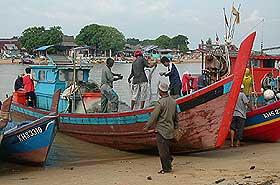 Umno came to prominence because of their strong grass-roots participation and leadership, with their national delegates coming mainly from local village heads, teachers, writers, journalists, and even fishermen.
They had a critical sense of mission, to make great sacrifice to lift the members of their ethnic community from socio-economic marginalisation at a time when the Malayan economy was still agro and commodity based.
The clarion cry for Malay unity to ensure the survival of the Malay race then did strike a resonant chord among the Malay voters.
That was the historical force that propelled and maintained Umno in power for many decades.
Time running out for racial politics
In the Hegelian sense, Umno dominance in Malaysian politics in the first few decades and the NEP created since the 1970s had their historical justification up to a point.
But even as early as the 1970s and 1980s, there were more than a few activists and students of politics like me who constantly went against the grain and claimed that the politics of race cannot be sustained over a long period of time without its many internal self-contradiction imploding from within to warrant its demise.
Any ethnic community is not a race cast in stone. It goes through socio-economic change, which itself creates cultural, intellectual and therefore political change.
Even the sense of ethnic self-identity goes through a painful process of self-examination and evolutionary transformation.
No doubt, the affirmative programmes implemented by Umno have transformed the Malay community and the face of the Malaysian political landscape.
In the process, they have also planted the seeds of their own demise through the unintended consequences of their success.
They have created a huge urban Malay middle and middle-upper class Malays whose higher educational levels nurture in them greater expectation of life, along Maslow's Pyramid of Needs.
They are far more financially independent than their parents from Umno's network of patronage, and increasingly face the same problems with their Chinese and Indian counterparts living within the sprawling urban centres, like high crime rate, congestion, rising costs of living, and the effects of rampant corruption.
Pivotal moment: Anwar's black eye
With the advent of the Internet since the 1990s, the younger generations of better educated Malays have also become much better informed than their rural forebears, and their mastery of the information technology has enabled them to find an individual voice, in seeking social networking and alternative expression of political views.
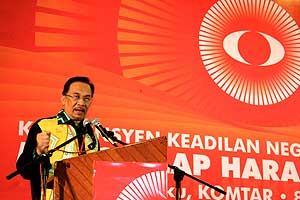 Looking back, the one single incident that woke up many young educated Malays from their racial slumber was the arrest and protracted trial of Anwar Ibrahim in 1998.
Suddenly, many New Malays were brought to the realisation that a prominent mainstream Malay icon can also be brought to the same humiliating state as leaders of opposition parties representing other ethnic communities.
The massive spontaneous street protests in 1988 against Anwar's arrest, and Anwar's black eye were the two symbolic historic events that sounded the death knell of "Malay dominated institutions to ensure Malay dominance in all things Malaysia"!
But with their supreme leader jailed in Sungei Buloh, the newly formed PKR party had to languish in the political wilderness for a decade before a congruence of historical forces opened up a new political sky in the March 8 general elections last year.
Meanwhile, Umno is no longer the vibrant grass-root based egalitarian activist movement of the 1950s and the 1960s.
Today, the delegates at the Umno general assembly are prominent titled and well fed members of the politico-corporate elite class, beneficiaries of crony capitalism, regional warlords who hamper the progress of the party every step of the way out of self-interest and their territorial imperative.
Naturally, money politics runs rampant in Umno, and the party turned from liberator of their race into the repressor and exploiter of many members of their own race.
In many ways, Umno has lost its old moral authority to call themselves political representatives of their ethnic community.
To-day, the Malay constituency in West Malaysia is split among Umno, PKR and PAS, locked in a titanic war for the Malay heart and soul. How will this drama play out in the end?
We take the current raging debate over the Biro Tatanegara civic courses for instance.
A Malay Menteri Besar from a Malay State - PKR's Tan Sri Khalid Ibrahim -- was the one who opened the Pandora Box by banning state civil servants and students from state institutions of higher learning from attending the BTN courses run by the prime minister's department.
This measure was soon followed by Penang and Kelantan.
Many PKR leading lights who are former Umno government members and well versed with the racist agenda and the dubious modus operandi of the BTN courses had since come out with much expose and condemnation of the transgressions committed by BTN courses in their new found aspiration towards Ketuanan Rakyat.
Then the national audience in Malaysia is entertained to a macabre and surreal shouting match between the former Prime Minister Tun M and the current Minister in the Prime Minister's Department Nazri Abdul Aziz accusing each other as being ‘racist"!
Tug of war between old and young
After 60 years of politics of race in mainstream politics, "racism" has finally been declared politically incorrect! This is indeed a historic achievement for our Malaysian democracy.
But apart from Tunku Razaleigh Hamzah's lone Umno voice for the scrapping of the BTN courses, Nazri is the only government minister announcing that the courses will be "revamped" to reflect the 1Malaysia concept so much touted by Prime Minister Najib Abdul Rajak.
While the PM himself is on a roller coaster of a global tour, many members of the present cabinet from the Deputy Prime Minister Muhyiddin Yassin down have insisted that there is nothing wrong with the BTN programme.
Nazri belongs to a younger generation Umno leaders who may not have the racial baggage of the old timers, and who sense the need for the party to evolve into a more inclusive political entity to meet the needs of new voters and new political realities.
The fact that he has not been vociferously supported by his cabinet colleagues while brickbats from his party comrades were hurled at him subtly or blatantly showed that many top Umno leaders are still addicted to their old perception of social engineering and patriarchal top-down leadership as the panacea of all their problems!
It does mean that Umno is still stuck in their time warp and for various reasons they have refused to accept the changing reality of race relations in Malaysia.
Any management guru will tell you that in a fast changing world, any entity that refuses to change to adapt to its new environment, let alone managing the pace and direction of change, is bound to be made obsolete and discarded by the evolving world.
If Umno is indeed bent on holding on to their brand of politics of race, is becoming obsolete their inevitable fate?
(Sim Kwang Yang can be reached at kenyalang578@hotmail.com )


