




An enduring gent's last hurrah
Except in the left's halcyon days in the late 1950s and early 60s, this shade of the ideological spectrum was sparsely represented in Malaysia’s two parliamentary chambers – the Dewan Rakyat and the Senate.
Except in the left's halcyon days in the late 1950s and early 60s, this shade of the ideological spectrum was sparsely represented in Malaysia’s two parliamentary chambers – the Dewan Rakyat and the Senate.
External threats - the Indonesian Confrontation (1963-65) and communist-led wars of national liberation in Indochina - combined with a lingering insurgency at the Malaysia-Thai border and in parts of Sarawak in the 1960s, to enable the then Alliance government to sustain spurious grounds for the detention of the non-militant left’s leading lights under the ISA.
Alliance leaders had no qualms exploiting the bogey of communism to keep the cream of the left in the Labour Party and Parti Sosialis Rakyat Malaysia (PSRM) cooling their heels in Kamunting rather than jousting with their right wing opponents in Parliament.
Thus Ahmad Boestamam, Karam Singh and Burhanuddin Al-Helmy (albeit of PAS, yet sympathetic to the left) spent the better part of their elected years from the late 1950s to the mid-1960s languishing in detention instead of espousing socialist nostrums in Parliament.
When newly-formed Parti Gerakan Rakyat Malaysia attracted Dr Tan Chee Khoon and V David, both of the Labour Party, to join them in 1968, the left was bereft of parliamentary representation.
This scenario of a MP-less left in Parliament rendered a certain forlorn valor to the attempts of PSRM's Kassim Ahmad to gain Parliament from Kuala Terengganu (1974 general election) and, after a spell under ISA detention (1976-81), from Balik Pulau in 1982.
The left's best chance
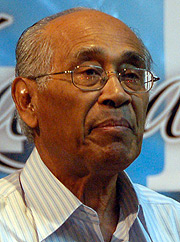 The void would not have persisted into the 1990s and beyond had Dr Syed Husin Ali won on a Parti Rakyat Malaysia ticket in the 1990 GE.
Circumstances that year combined to provide the then retired academician with the left's best chance to win a seat in Parliament after the drought of the preceding period.
The conditions for that were notably propitious. The fallout from Umno's battle royale in 1987, when Dr Mahathir Mohamad narrowly defeated Tengku Razaleigh Hamzah for the party presidency, saw the loser setting up the Umno splinter, Semangat 46.
Razaleigh went on to initiate Gagasan Rakyat (people’s might) which linked Semangat to PAS, DAP and the minuscule Parti Rakyat in a loose coalition to fight BN at the polls.
When Parti Bersatu Sabah (PBS), steered by Chief Minister Joseph Pairin Kitingan, joined Gagasan following an eleventh-hour defection from the BN, the latter looked in danger of losing for the first time since 1969 its two-thirds majority in Parliament.
Umno's internecine troubles, a spate of ISA detentions in late 1987, the banning of national newspapers, the sacking of Salleh Abbas as head of the judiciary, plus the exhilarating insurgency of Umno dissident Shahrir Samad in a by-election in Johor Baru in August 1988 - all set the stage for a keenly anticipated general election in October 1990.
In the prelude to nomination day, the DAP was persuaded to leave the Federal Territory constituency of Batu for the Parti Rakyat president to contest.
This enabled Syed Husin to be fielded in an eagerly anticipated straight fight with BN's Alex Lee (Gerakan), the incumbent MP.
Alex Lee knew he was in a close battle with Syed Husin, whose stature as an honest and durable exponent of an, albeit, fading political ideology (the Berlin Wall had fallen 11 months before the October 1990 GE) invested his attempt to enter Parliament with the same tincture that Kassim Ahmad's tries had sported, save in one aspect.
Whereas Kassim's attempts were doomed to a sort of noble failure; improbably, there was a premonitory glint of victory to Syed Husin’s chances in 1990.
Long running drought set to end
The fact that Batu had a mixed race electorate (the Malay component equaled the combined Chinese and Indian-voter totals), with a working class majority, made the seat particularly apposite for a socialist candidate’s triumph, bearing in mind the left’s aversion for racial politics and its affinity for proletarian interests.
Furthermore, in its 1990 delineation, the seat included wards that had once composed Setapak, the constituency from which Boestamam, the left’s iconic leader of the 50s, had been elected to Parliament in the 1959 GE.
Thus the 1990 GE loomed as the occasion when the long running drought of socialist representation in Parliament was set to end.
The demographics of the Batu constituency and its historic affinity for socialist tribunes dovetailed nicely in 1990 with mounting unease over Mahathir’s authoritarianism.
Thus, though DAP's Lim Kit Siang's contest with Penang Chief Minister Dr Lim Chong Eu (Gerakan) for the state ward of Padang Kota in Penang and P Patto’s (DAP) fight with MIC president S Samy Vellu in Sungai Siput were the more riveting match-ups, the Batu battle between Alex and Syed Husin was the more interesting for what it revealed of historical trends and the trajectory of individual careers.
Alex was a product of privilege, the Cambridge educated lawyer-turned-banker son of Malaya's first finance minister HS Lee, but he had empathy for the underprivileged and was popular by the end of his first term (1986-90) for reason of his success at obtaining City Hall help in deepening the Batu river and its tributaries, whose overflow during rainy spells brought recurrent woe to low-income residents of the constituency.
Also, generous allocations, both from state and personal funds, to the building of community halls in his constituency reduced the cost of social rituals, such as weddings, for residents.
Alex was at that stage of his career when in realizing that life had given him much, he was intent on giving back to society. That the majority of his constituents were from a rung opposite to the one from which Alex had started, provided him with the perfect goad for his nascent communitarian instincts.
In contrast, Batu Pahat-born (in 1935) Syed Husin needed no promptings from the vaguer sanctions of conscience to display socialist instincts. The scion of a family of modest means which was politically conscious, Syed Husin sought the path of academic study of the socio-political questions of his time. He equipped himself with degrees up to Phd. to teach students – among who was one Anwar Ibrahim - at Universiti Malaya. Along the way, he suffered almost six years in detention under the ISA (1974-80), an internment rendered unconscionably long for reason of his usefulness as cover for a power play within Umno.
In 1990, he retired from lecturing and after Kassim Ahmad had given up the PSRM leadership a few years earlier, Syed eased behind the stern and began, imperceptibly, to shift the party – after the fall of the Berlin Wall in 1989 - from its ideological moorings in doctrinaire socialism. The subsequent link-up with Razaleigh’s populist Gagasan coalition was not such a hard thing to do.
With Gagasan fast gaining popularity, the 1990 GE threw up the attractive possibility, for the first time since independence in 1957, that all presidents of opposition parties would be elected to Parliament, an outcome that would boost democracy for reason of Parliament’s suitability as the arena for all political ideologies extant in the Malaysian body politic.
This was good news to PAS' Fadzil Noor who, having taken over the presidency from the just retired Yusof Rawa, had struggled to get elected from Kedah, an Umno bastion, and it was also welcome news to Syed Husin who was set to end the drought in the left’s representation.
But alas, fate would ordain otherwise. The eleventh hour withdrawal of the PBS saw BN's state-owned propaganda apparatus working overtime to play on Malay/Muslim fears that the largely Christian Kadazan-Dusun of Sabah were engaged in a foreign-backed plot to use Razaleigh's Gagasan as a Trojan Horse to gain political ascendancy.
The 'sigah incident'
This was in the era before the internet, so Gagasan were helpless before the onslaught of a BN controlled media that painted Razaleigh a stooge for Christian designs. Television, in particular, endlessly ran footage of the Semangat 46 leader sporting the headgear that Pairin had foisted on Razaleigh when the latter arrived for a PBS function. The symbol on the headgear looked suspiciously like a cross; in reality the symbolism had more to do with agriculture than religion.
The Malay-Muslim vote, ready for the first time since the 1969 GE, to give some share to the opposition, panicked and stayed with the Umno-led BN.
In an interview with Malaysiakini after his nomination by the Selangor state government as senator, Syed Husin recalled the effects of the 'sigah' (headgear) episode in the 1990 GE:
"Until three days before the election most people, including those from the media and intelligence, were confident of my victory. Then came the ‘sigah’ incident, for which Tengku Razaleigh and the Gagasan he led were accused by the BN and its propaganda machinery of being Christian agents.
"I could feel the Malay/Muslim sentiments suddenly turning against us. A day before voting I knew I had lost. Nevertheless the loss was by a relatively small margin of over 3,000 votes out of more than 60,000 votes cast."
Fadzil Noor, too, lost in Pendang and instead of Parliament shedding its lopsidedness through a BN-loss of its two-thirds majority, it looked more stratified then ever along racial and religious lines - between an Umno-preponderant BN and an opposition dominated by the DAP.
Undaunted, Syed Husin continued to soldier on, gently moving Parti Rakyat towards the centre of Malaysian politics. When Parti Keadilan Nasional, the forerunner of PKR, was formed in April 1999, he led his party into alliance with it and prepared for the 1999 GE, the election that was supposed, at long last, to see BN lose its two-thirds majority as a result of a backlash from Malay-Muslim voters resentful of the way Anwar Ibrahim had been sacked and publicly traduced by Mahathir.
Syed Husin stood in Petaling Jaya Selatan, again on DAP sufferance, and was headed for victory when non-Muslim voters, frightened by PAS' insistence on an Islamic state, fought shy of giving the Barisan Alternatif (Alternative Front) one-third representation in Parliament. The BA was the opposition group that united Keadilan, DAP, Pas and Parti Rakyat in a loose political and electoral understanding to fight the BN.
Syed Husin's jinxed electoral fortunes would persist at the next GE in 2004 when he, now installed as deputy president of the entity that resulted from Keadilan’s merger with Parti Rakyat in 2002, was shaping to contest in Kota Bharu, a seat where the incumbent was a PKR MP.
Syed Husin received support from the top leadership of PKR, including Anwar who sent word from prison that he was in favor of the deputy president contesting in the Kelantan capital. But the state's political numero uno, Nik Abdul Aziz Nik Mat, squashed the move by publicly expressing his reservations about the suitability of Kota Bharu being represented by a socialist - the Tok Guru's conception of Islamic rectitude barred anyone with a past of vaguely ‘godless’ beliefs.
Syed Husin says of that episode: "The top leadership of the party, especially (Dr) Wan Azizah (Wan Ismail) and Anwar were very supportive. But there were certain elements in the party (PKR) that were against me because of my PRM past."
"They joined forces with the group within PAS that wanted a candidate of their own choice. They managed to influence Nik Aziz. Once the Tok Guru spoke it was difficult. But I knew all along many in the PAS leadership, too, were seriously in favor of me."
Thus Syed Husin had to sit out the 2004 GE and by the time of the 2008 one, felt himself, at 73, a little past it and so declined to contest although a seat within the ambit of the Klang Valley would have easily been his for the asking, if not exactly, taking.
'Rational and sober voice'
The PKR-led Selangor government's nomination of him to the Senate is mild solace for a career frustratingly cheated of its parliamentary dues. Needless to say, Syed Husin is not taking his appointment lightly.
"I know that the Senate has never been effective. Nevertheless, I hope to be able to bring up and debate various issues seriously and consequently be respected as the people's rational and sober voice for change, unity, justice, truth, ethics, fair play and concern for the poor and marginalised.
"I will continue to raise issues that have always concerned me, such as rural and urban poverty, corruption, fundamental human rights – including rights to decent housing, good education and free or affordable medical care, good governance, national integration, responsible and ethical public service, and so forth."
In other words, all the concerns his predecessors in the national socialist pantheon had espoused but the demons of a repressive era elected on foreclosure through ISA detention.
Syed Husin, into the eight decade of a long life's march, is not likely to scant any opportunity, even in the lower register of the Senate, to keep his social democratic ideals salt and sane.


