




Jui Meng: Either way Pakatan wins
Chua Jui Meng, who recently defected from Barisan Nasional to join PKR, shared some interesting insights at a Pakatan Rakyat seminar last weekend that ought to fortify hope the coalition is riding a wave.
Chua Jui Meng, who recently defected from Barisan Nasional to join PKR, shared some interesting insights at a Pakatan Rakyat seminar last weekend that ought to fortify hope the coalition is riding a wave.
His tidings were particularly welcome to a coalition whose steep setback suffered in the Bagang Pinang by-election last month not only introduced new doubts about its prospects for victory at the next general election but also renewed old anxieties about its viability.
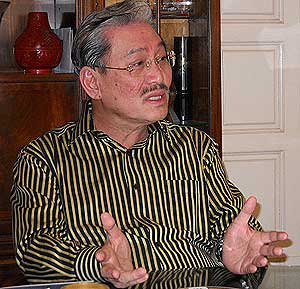 Chua, a compelling speaker who in tandem with PKR supremo Anwar Ibrahim has gone on the hustings early, told the seminar on a two-party system that there were two future scenarios for Malaysia.
One would either place Pakatan at the helm of the federal government in Putrajaya or the other would see BN continue to rule by preemption of Pakatan's agenda. He said the second scenario was tantamount to victory for Pakatan.
Anwar has been over into BN's future
He implied that these two prospects were due to the trail-blazing of leaders like Anwar "who has been over into the BN's future and seen that it does not work."
This is a slight modification of a famously pithy expression by the American journalist Lincoln Steffens who visited the new Bolshevik creation - the Soviet Union - in 1919 and returned two years later with the early verdict: "I've been over into the future, and it works."
(The Soviet Union disintegrated in 1991, some 70 years after Steffens' exuberant prophecy).
Chua outlined the reasons for his optimism that Pakatan would gain victory either through direct endorsement by the people or by preemption of its agenda by BN.
"When Anwar first submitted his Malaysian Economic Agenda to the people many, myself included, who shared his aspirations, thought he was ahead of his time," he said.
The former MCA leader said in 2007 when Anwar proposed the MEA, the idea of abolishing or amending the NEP was considered taboo.
"Now such discussions are becoming commonplace. People have rediscovered the freedom to express their views on the issue and move beyond the rhetoric into the pragmatic," he said.
"Specific policies can be looked out without fear or sabotage by slanderous accusations of treachery or playing the race card and inciting groups to fear," he added.
However, in this new climate of open discussion and debate on websites and blogs, made possible by technology's conferment of expressive power to the hitherto powerless, Chua said it would be a mistake for the people of Malaysia to relegate the task of critical scrutiny of policies to someone else's responsibility.
He held that for leaders to guide this task they have to reeducate the people which "is an effort that starts at home and in communities where families and schoolteachers begin to preach a new message and businessmen finds ways to incorporate the ideals of fairness and justice into their activities, not because it is easy but because it is the right thing to do."
He said the two-party system raised hope that the nation would finally shed the painful legacy of race-based politics.
Constitution has 'evolved down'
Recalling immediate past, the period between Anwar's enunciation of the MEA and the general election of March 2008, Chua said:
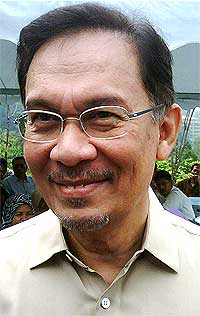 "At that time I was on the other side - and the election was for many in BN a wake-up call. We did not believe that a multi-racial agenda was viable given the limitations and the overwhelming power of the race-based political system.
"We thought the majority of the Malaysian people would reject anything that diverged too drastically from the status quo.
"We certainly did not expect the three disparate opposition parties (PKR, DAP and PAS) to forge an alliance that could withstand more than a few below-the-belt attacks from the mainstream media. We were decisively wrong."
Chua held that the Malaysian constitution at the country's birth was a "reasonable compromise among the many competing interests and factions that coexisted in Malaysia under British rule."
"It was important to craft a document that recognised and legitimised the aspirations of all without marginalising anyone at the expense of another.
"Article 153 (on Malay rights) is viewed as most controversial but it cannot be ignored that the Yang Di Pertuan Agong was also given the responsibility to ensure the rights and fair treatment of non-Malays," he noted.
But unlike other democracies, Chua observed that "rather than evolving up our constitution has evolved down."
"Having been emended over 40 times over 52 years of our independence and subjected to over 700 aberrations, some Malaysian legal scholars have stated that 'the spirit of the original document has been diluted', " he said.
Chua argued that the original constitution took note that though race was a defining factor, it was not intended to be a barrier or obstacle for the nation to progress.
He also held that the original document clearly expressed an aspiration for a democratic society that was just and equitable.


