




Malaysia Day holiday - much ado about nothing
Many East Malaysians have been clamouring around August every year for Sept 16 to be made a National Day without knowing or understanding the vagaries of history and the issues and complexities surrounding the formation of Malaysia.
Many East Malaysians have been clamouring around August every year for Sept 16 to be made a National Day without knowing or understanding the vagaries of history and the issues and complexities surrounding the formation of Malaysia.
Let me, as an amateur historian, go back to first principles.
In July 1955, the Alliance, comprising Umno, MCA and MIC won 51 out of the 52 seats of the Malayan Federal Legislative Assembly and effectively attained 'self-rule' in colonial Malaya.
On Aug 31, 1955, at the Umno General Assembly following the Alliance's electoral triumph, a resolution was proposed to urge the party leaders to seek political independence from the British colonial power "within two years".
Another delegate was reported to have amended the resolution by the addition of 'insyallah' (God willing) at the end of the resolution as according to him, to demand independence within a strict time frame was arrogant and not in keeping with the psyche of the humble Malays.
With great amusement, the amendment was accepted and the resolution passed by acclaim.
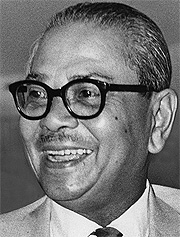 And so it was that the Merdeka Mission set sail for London in December 1955. That mission was a success and Tunku Abdul Rahman (
right
)came back in January 1956 and fittingly announced the "end to more than 400 years of foreign subjection" (in Melaka, where in 1511, the country first fell to foreign domination) on Aug 31, 1957, in accordance with the Umno General Assembly resolution.
And so it was that the Merdeka Mission set sail for London in December 1955. That mission was a success and Tunku Abdul Rahman (
right
)came back in January 1956 and fittingly announced the "end to more than 400 years of foreign subjection" (in Melaka, where in 1511, the country first fell to foreign domination) on Aug 31, 1957, in accordance with the Umno General Assembly resolution.
The tonal significance of that date was soon explained to Tunku by his Chinese friends to be sang yet fatt (Cantonese pronunciation for 318) which could be homophonous with prosper from birth. That fact was never lost on the Tunku.
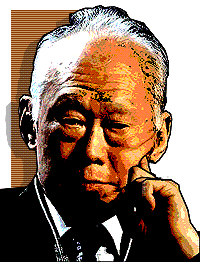 When the concept of an enlarged Federation of Malaya was publicly mooted (actually forced by the British, effete after a debilitating global conflict called WWII, wanting to shed its responsibilities for far-flung territories that were not of strategic importance) by Tunku in a speech in Singapore in May 1961 to the Foreign Correspondents Association of Southeast Asia, it was very readily accepted by Singapore's Lee Kuan Yew (
left)
, who, without Malaysia, would have had his fragile PAP government overthrown by Lim Chin Siong's Barisan Sosialis.
When the concept of an enlarged Federation of Malaya was publicly mooted (actually forced by the British, effete after a debilitating global conflict called WWII, wanting to shed its responsibilities for far-flung territories that were not of strategic importance) by Tunku in a speech in Singapore in May 1961 to the Foreign Correspondents Association of Southeast Asia, it was very readily accepted by Singapore's Lee Kuan Yew (
left)
, who, without Malaysia, would have had his fragile PAP government overthrown by Lim Chin Siong's Barisan Sosialis.
Popular misconception by East Malaysians
With the British twisting his arms, Tunku was forced to accede to many demands including the 18/20 safeguards, which were to have been transitional provisions to protect the more backward East Malaysians from the more advanced and aggressive people from Singapore and Semananjong .
This gave rise to the popular misconception by many East Malaysians that during those negotiations, the Federation of Malaya was of standing as equal partners of the Crown Colony of Singapore, the State of Sarawak, the State of North Borneo and that the four equal entities joined to form the Federation of Malaysia.
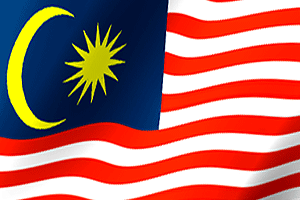 These East Malaysians failed to distinguish substance from form. In substance and in effect, the Federation of Malaya was to take on three new member states to add to the 11 it already had. The 11-point star on the flag was amended to 14. The 11 stripes were raised to 14.
It was synonymous with the growth of the USA from the original 13 states, culminating in the joining of the 50th state of Hawaii in 1959. When that happened, the number of stars on the US flag was increased to 50.
The slight name change from Malaya to Malaysia has also been erroneously cited to bolster the notion that four equal parties, Singapore, Sarawak, North Borneo and the Federation of Malaya came together to form a new political entity.
Whilst the first three were then colonial possessions of the British Government, the Federation of Malaya was already an independent nation with membership in the United Nations Organisation (UNO).
Many East Malaysians still harbour the misconception that Tunku, a prince and the Prime Minister of an independent country was talking to Lee Kuan Yew and the community leaders in Sarawak and North Borneo as equals.
He was simply and plainly coerced (by the British for its defence) to make Malaysia happen even if it meant acceding to demands and conditions (which became part of the 18/20 points in the Malaysia Agreement).
Threat from Indonesians
The various background paperwork and enabling acts and ordinances in the legislatures of Britain, Malaya, Singapore, Sarawak and North Borneo to bring about the establishment of Malaysia were all dated Aug 31, 1963 (Tunku never wavered in his love for the sang yet fatt homophone).
Don't take my word for it ... go to the archives and see for yourselves.
Alas, trouble beckoned from next door. Indonesia's Sukarno, wishing to avert attention from the ill-effects of his rule, started ranting about neo-colonialism and questioned the verity of the new enlarged entity called Malaysia.
To appease a close neighbour, Tunku agreed to a fact-finding mission to be sent by U Thant, then secretary-general of the UNO to ascertain the wishes of the people of Sarawak and North Borneo.
In the event, due to problems such as transport and the far-flung nature of these two huge states, U Thant's mission could not issue its report in time for the Aug 31 deadline and reluctantly, Tunku had to postpone the proclamation of Malaysia to a later date some two weeks after the scheduled Aug 31.
Throughout the history of modern Malaysia, the Sept 16 date has been treated as an unintended aberration and in future years, the annual celebration date reverted to Aug 31.
Be that as it may that Sept 16, 1963 was historically the correct date of the entry of Singapore, Sarawak and North Borneo into Malaysia, it shouldn't be the case that it should now be celebrated as the Independence Day.
When Hawaii joined the United State on Aug 21, 1959, it did not demand that henceforth the rest of USA should abandon the Fourth of July and celebrate National Day on Aug 21.
Any Cantonese will tell you 169 sounds like yet loke kaw or ‘play all along the way'. No wonder Tunku never ever wanted to celebrate Sept 16.
I have great sympathy for the grouses of East Malaysians. Everything seems to cost more than in Semananjong. Compared to tiny Brunei, the only one of the Borneo threesome to opt out of joining Malaysia, they seem to be lagging behind.
But the answer to their woes is definitely not getting Sept 16 recognised as National Day.
Thus rejoicing at yet another holiday would seem to me as pandering to the irrelevant or much ado about nothing.
Footnote: The Federation of Malaya, surrounded by a belligerent Indonesia, was most vulnerable in defence and Britain used the continued defence umbrella by itself and the Commonwealth (read as Australia and New Zealand) to coerce the Tunku to take in Singapore, Sarawak, North Borneo and Brunei.
Uncle Yap is a retired Chartered Accountant who spends quite a fair bit of his time reading old newspapers in the National Archives in pursuit of his interest in Malaysian history. He also runs BeritaMalaysia, a free Internet news service catering for the happenings in Malaysia and its immediate neighbours.


