




Najib's double dilemma
COMMENT As the embers die out from MCA’s shocking EGM and the Bagan Pinang by-election results, Barisan Nasional (BN) head Najib Abdul Razak is faced with a major dilemma: How much does he really need the non-Malay component parties to win back popular support?
This is far from a rhetorical question.
COMMENT As the embers die out from MCA’s shocking EGM and the Bagan Pinang by-election results, Barisan Nasional (BN) head Najib Abdul Razak is faced with a major dilemma: How much does he really need the non-Malay component parties to win back popular support?
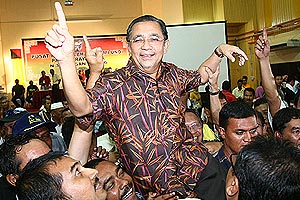 This is far from a rhetorical question. Isa Samad’s larger than unexpected win in Bagan Pinang - including winning more than 70 percent of the popular vote in the Indian Malaysian majority polling districts of Ladang Atherton, Pekan Siliau, Ladang Bradwall and Sua Betong - came in the context of a still unpopular MIC.
In a recent Merdeka Centre Survey, 68 percent of Indian respondents had an unfavourable perception of MIC after its party elections. But Isa’s local popularity, coupled with Najib’s strategic reaching out to the newly-formed Malaysian Makkal Sakti Party, was sufficient to swing the Indian vote, at least in this constituency, back to the BN.
At the same time, the implosion within the MCA has paved the way for the exit of arguably the most popular leader among the Chinese community, relatively speaking. In the same Merdeka Centre survey, 60 percent of Chinese respondents who gave a positive response wanted Ong Tee Keat to stay on as MCA president.
This should not be particularly surprising. Even though Tee Keat’s reputation has been somewhat tainted by the revelation that he accepted rides on a private jet belonging to Kuala Dimensi Sdn Bhd, the very company that has been implicated in the Port Klang Free Zone scandal, he’s the only MCA leader who has shown some chutzpah in allowing an independent audit to reveal some extent of corruption and wrongdoing in this fiasco.
Furthermore, the Chinese community is not particularly interested in Tee Keat’s demeanor within the MCA, where some have accused him of being aloof and arrogant; this probably increased his unpopularity within the party.
 The impression which most Chinese have of Tee Keat is that of a an independent maverick who speaks truth to power, in a manner of speaking; is a learned and cultured leader; and probably the best hope to pull MCA together before the next general election. In getting rid of him, the MCA delegates have inevitably shot themselves in the foot.
It does not seem likely that he will stay on as president, given his earlier promise to step down if he lost the vote of confidence. If fresh party elections are held, as they likely will be, the leader who emerges, regardless of whether it is Ng Yen Yen, Ong Ka Chuan or Liow Tiong Lai, will not have the same national stature as Tee Keat.
Emasculated parties
Herein lies part of Najib’s dilemma. He is already under some pressure from Umno to take back some of the Malay-majority seats from the non-Malay BN component parties. The current MCA crisis presents Najib with an opportunity to test MCA’s reaction to such a scenario.
 I wouldn’t be surprised if Umno insiders are already pressuring Najib to take away a cabinet position from MCA or to take away an important portfolio like the Transport Ministry in exchange for a less influential ministry. In their current state of disarray, MCA leaders would be powerless to protest. But in making this decision, Najib would leave the MCA in an even more weakened position.
In a sense, all three non-Malay component parties in the BN have already been somewhat emasculated in their respective cabinet allocations. This has happened with little public backlash against these component parties, which illustrates the relative weakness of these parties in the eyes of non-Malay voters.
The exclusion of Gerakan from the cabinet for many months hardly raised a whimper from Gerakan leaders and supporters. The same can be said of the loss of the influential Works Ministry by the MIC. MCA was given the less influential Tourism Ministry while the Human Resource Ministry was allocated to the MIC.
The temptation for Najib to reach over the heads of the non-Malay component parties in Peninsular Malaysia is hard to resist. Bagan Pinang is an indication that a popular Umno candidate backed by strategic moves by the prime minister can reap electoral rewards, even when the MCA, MIC and Gerakan are in disarray.
As long as these parties do not seem capable of pulling their weight within the BN, Umno’s natural instinct to increase its political dominance is likely to kick in.
Redrawing the lines
There will be a strategic opportunity for Najib to put such a plan in action. The next constituency delimitation exercise should take place in 2011. But unlike previous delimitation exercises, the BN does not have a free hand in increasing the number of parliamentary and state seats because it does not have two-thirds control of Parliament and of six state legislatures.
But this does not prevent the BN from influencing the EC to redraw boundary lines within individual states. This was exactly what happened in the state of Kedah in the 2003 delimitation exercise.
 It would not be difficult for boundary lines to be redrawn to further increase the proportion of Malay voters in seats such as Kuantan in Pahang and Bandar Tun Razak in Kuala Lumpur, both of which are Malay-majority seats currently contested by MCA.
This would obviously expedite the process for Umno to claim (or reclaim in the case of Kuantan) these seats.
If Najib is unsure of his ability to win over Chinese voters, boundary lines can always be redrawn in Penang, Perak, Selangor, Negri Sembilan and KL (all of which have significant proportions of non-Malay voters) so that the non-Malay areas are further under-represented. Such a move would coincide with a reduction in the number of parliamentary and state seats allocated to MCA, MIC and Gerakan and further increase Umno’s dominance.
In such a scenario, Umno would get the best of both worlds. It would increase its own power within these states by further increasing the number of Malay majority seats, where it has greater confidence of winning (or winning back).
If the non-Malay vote does come back to the BN, Najib would obviously reap the electoral rewards. But if it doesn’t, the opposition vote and seats would be restricted to a smaller number of non-Malay majority seats. After March 2008, Najib cannot take the risk of losing these states again even if it means the further marginalisation of the non-Malay component parties.
Such a move is not unprecedented. This was exactly what happened after the 1969 general election. MCA was emasculated and it was powerless to prevent the creation of the Federal Territory of KL, which turned Selangor into a non-Chinese majority state.
Such a move is waiting to happen again. This weekend events have just increased the odds of such a repeat performance.
Najib’s dilemma of choosing between the short-term goal of winning back two-thirds control of Parliament and control of key states on the one hand, and further marginalising MCA, MIC and Gerakan on the other, will be on his mind from now until the next general election.
Ong Kian Ming is a PhD candidate in Political Science at Duke University.


