




No free entry into Sabah, say Kitingans
The two Kitingan brothers in politics, Joseph Pairin and Jeffrey Gapari, once again find themselves on the same side of the political divide.
The two Kitingan brothers in politics, Joseph Pairin and Jeffrey Gapari, once again find themselves on the same side of the political divide.
The duo were the first to register their opposition to the possibility of Sabah opening up to Peninsular Malaysians freely entering the state to settle down, work and do business.
"1Malaysia doesn't mean doing away with Sabah's rights over immigration when it comes to entry from Peninsular Malaysia," say the brothers.
"We are against any move to open up, at least for the moment."
The Kitingans were responding to a suggestion by Liberal Democratic Party (LDP) deputy president Chin Su Phin's call for a "1Malaysia look at Sabah's immigration powers", several days ago.
Chin was making his suggestion during a meeting with state party branches.
Jeffrey is noted for his campaign for the 20 Points Sabah rights, under which the state joined Sarawak, Singapore and Malaya in the new Federation of Malaysia.
The brothers are also against doing away with the work permit ruling for non-Sabahan Malaysians, including Sarawakians, in the state.
 "It is very important for us to be protective of our rights and interests," said Pairin (
left
), also the deputy chief minister and president of the Parti Bersatu Sabah (PBS).
"It is very important for us to be protective of our rights and interests," said Pairin (
left
), also the deputy chief minister and president of the Parti Bersatu Sabah (PBS).
"This will give the assurance and confidence to our local people who still seek justice and fair share in work and other opportunities."
He said the work permit requirement was part of Sabah's rights and interests which were already agreed upon in the country's immigration laws and the Constitution.
Pairin cautioned fellow BN component parties against making any statement which would be detrimental to the interests of Sabah and Sarawak.
"We are not ready to let it (immigration powers) go," said Jeffrey who is a vice-president of PKR.
"There is a reason why we need immigration control over some things. We are still 20 years behind. We need to protect the job opportunities in the state for the good of our people."
More locals, less outsiders
 Instead, Jeffrey (
left
) called for the pace of 'Borneonisation' to be stepped up and non-Sabahan Malaysians heading government departments in the state be replaced with locals.
Instead, Jeffrey (
left
) called for the pace of 'Borneonisation' to be stepped up and non-Sabahan Malaysians heading government departments in the state be replaced with locals.
This appears to be the main reason why the Kitingan brothers, if not others, are against the prospect of free entry for Peninsular Malaysians.
Sabah's immigration powers over entry from Peninsular Malaysia, does not cover legitimate federal government business in the state.
Civil servants, police and the army cannot be restricted in any manner by the Sabah immigration.
Among others, several other Sabah leaders also took LDP to task for proposing free entry for Peninsular Malaysians and doing away with work permits for non-Sabahan Malaysians.
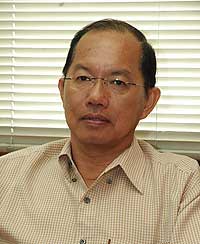 They include Sabah PKR deputy chief Kong Hong Ming
(right)
, Sabah Peoples' Progressive Party (Sapp) deputy president Liew Teck Chan, PBS supreme council member Chin Tek Ming, former Berjaya state minister and presently
New Sabah Times
executive chairman Ayub Aman,
They include Sabah PKR deputy chief Kong Hong Ming
(right)
, Sabah Peoples' Progressive Party (Sapp) deputy president Liew Teck Chan, PBS supreme council member Chin Tek Ming, former Berjaya state minister and presently
New Sabah Times
executive chairman Ayub Aman,
"LDP should use this issue during the next general election as a referendum," suggested Ayub.
"LDP leaders should not issue any statements at their whims and fancies that could erode the rights and interests of the Sabah people," fumed Chin Tek Ming of PBS.
"The status quo on the work permit requirement for Peninsular Malaysians and Sarawakians in Sabah should remain," said Liew.
"The issue is not about immigration rights but balanced development," ventured Kong. "Wages in Sabah are lower than in Peninsular Malaysia while the cost of living is higher. Immigration powers should stay," he said.
Briefly, Peninsular Malaysians entering Sabah are in the same immigration category as foreigners except for the fact that they can vote, stand in elections and freely buy land in Sabah.
Many Peninsular Malaysians, residents in Sabah, some up to thirty years have still no permanent resident status yet.
Not surprisingly, there is a perception that while Peninsular Malaysians have to be law-abiding, illegal immigrants can freely walk the land and even ignore periodic amnesty offers from the government.
For example, some 160,000 registered illegal immigrants - said to be the tip of the iceberg - still have no travel papers and are yet to pay their levy.
Lone voice of dissent
Anti-illegal immigration activist Dr Chong Eng Leong is in a minority of one.
He favours the granting of permanent residence status for Peninsular Malaysians, especially those resident in Sabah for decades.
"It is disheartening to hear Sabah political parties arguing against free entry for Peninsular Malaysians into Sabah and against the abolition of the work permit ruling for non-Sabahan Malaysians in the state," said Dr Chong.
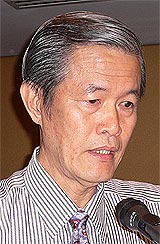 Dr Chong
(left)
reminded that Minister in the Prime Minister's Department, Nazri Mohamed, had revealed last year in Parliament that thousands of Filipino refugees in Sabah were quietly given permanent residence without consent, as required by the state government.
Dr Chong
(left)
reminded that Minister in the Prime Minister's Department, Nazri Mohamed, had revealed last year in Parliament that thousands of Filipino refugees in Sabah were quietly given permanent residence without consent, as required by the state government.
Again, Sarawakians can freely enter Sabah but cannot work without a work permit.
Former chief minister Harris Salleh did away with the immigration restrictions for Sarawakians.
His successor, Pairin, re-imposed the work permit ruling for Sarawakians when the Sarawak government failed to reciprocate Sabah's 1Borneo gesture.
"I didn't tell them (Sabah) to open up to us. If they want to open up, it's up to them," said Sarawak Chief Minister Abdul Taib Mahmud in his response to Pairin's demands for reciprocation.
"We don't intend to allow free entry for non-Sarawakian Malaysians."
The Immigration Department generally exercises discretion in the case of Sarawakians who have a Sabah address in their MyKad, long-time resident in the state and those who had their education locally.
Not vice-versa
There are no restrictions, if any, on Sarawakians applying for work permits in Sabah.
Work permit figures help the state in manpower planning and training programmes.
Interestingly, under the Interpretation of the Native Act, the Natives of Sarawak are also considered Natives of Sabah.
Natives of Brunei, Singapore, Malaya, Indonesia, and the Sulu Islands in the Philippines, similarly enjoy the same privilege "if they face no immigration restrictions".
In the case of Peninsular Malaysians in Sabah, their numbers are generally restricted to those in the state on government business.
This leaves only a very small number, a fraction of the 150,000 Sarawakians, who are in the state on their own.
In Chin's view, the people did not want to maintain the immigration restrictions but the politicians were opposed to changes.
At the very least, he is willing to water down his free entry suggestion to permanent residence by application if not automatic, for Peninsular Malaysians who have been in Sabah for 10 years or more.
Malaysians from Sabah and Sarawak can freely enter Peninsular Malaysia.
Their children still qualify automatically as Sabahans and Sarawakians even if they are born in Peninsular Malaysia.


