




CPM leader: Umno has failed the people
Abdullah CD could have been an influential retired politician today if only the course of history had been in his favour. He could have been a former menteri besar or minister.
However, unfortunately for him, the coin flipped the other side and he was destined to be remembered as a communist whose revolution had failed, as what Malaysian history books today say.
But that has never stopped him from keeping his ideologies alive. He has always believed that the ultimate rulers of Malaya, and then Malaysia, should be the people and not politicians who yield too much of power - be it the British colonisers or the subsequent Umno powerhouse.
Abdullah CD could have been an influential retired politician today if only the course of history had been in his favour. Indeed, he could have been a menteri besar or minister.
However unfortunately for him, the coin flipped the other side and he was destined to be remembered as a communist whose revolution had failed, as what Malaysian history books today say.
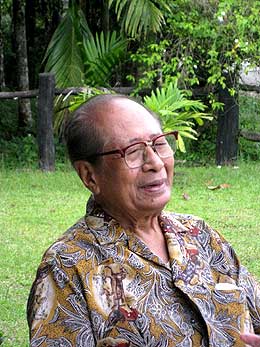 But that has never stopped him from keeping his ideologies alive. He has always believed that the ultimate rulers of Malaya, and then Malaysia, should be the people and not politicians who yield too much of power - be it the British colonisers or the subsequent Umno powerhouse.
"Umno can claim that they won independence for Malaya from the British. They can claim that our revolution failed.
"But, if you see what's happening in Malaysia today, I will say that our revolution is continuing and it will succeed very soon," said the 85-year-old war veteran with a twinkle in his eyes.
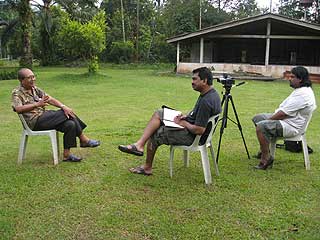
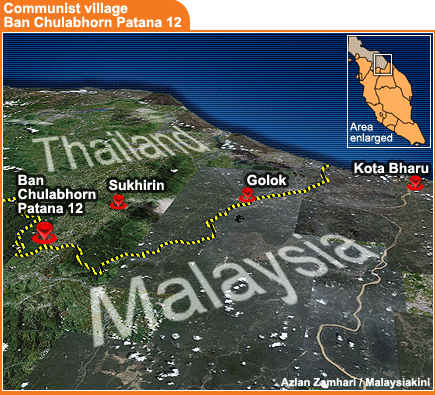
Abdullah CD, whose real name is Cik Dat Anjang Abdullah, has always been a left-leaning Malay nationalist and that belief was clearly apparent when Malaysiakini met him recently in his ‘peace village' in Southern Thailand.
He started off his campaign against occupiers during the Japanese occupation through his Kesatuan Melayu Muda (KMM), or the Young Malay Union. He then joined the communist-led Malayan People's Anti-Japanese Army (MPAJA).
When the British returned, he joined his esteemed peers such as Mokhtaruddin Lasso, Dr Burhanuddin al-Helmy, Ahmad Boestaman and Ishak Mohamad to form Malayan Malay National Party, or Parti Kebangsaan Melayu Malaya (PKMM).
PKMM was formed shortly before another Malay-based party called Umno - United Malay National Organisation - was set up.
Both the PKMM and Umno, though fighting for the same cause of having an independent nation, were however headed in opposite directions in the manner they went about in gaining that independence.
Umno will lose more
While the British accepted the Western-friendly Umno leaders, they banned PKMM and arrested many of its leaders and members, including Abdullah in 1948.
 Abdullah however managed to escape and the rest is history - he went on to form the fearsome all-Malay 10
th
Regiment of the Communist Party of Malaya in 1949 and waged a bloody war with his comrades to get rid of the British. He was also the chairperson of the party with Chin Peng being its secretary-general.
Abdullah however managed to escape and the rest is history - he went on to form the fearsome all-Malay 10
th
Regiment of the Communist Party of Malaya in 1949 and waged a bloody war with his comrades to get rid of the British. He was also the chairperson of the party with Chin Peng being its secretary-general.
In the battle for their revolution, he and his comrades became the mortal enemies of Umno and that animosity is still being felt today by both parties.
Abdullah is presently still in charge of his comrades although they had laid down their weapons in 1989 after signing a peace deal with the Malaysian and Thai governments.
He and his troops from the 10th Regiment are now living in a village in southern Thailand but 20 years after the peace deal, Abdullah has not lost any of his fire for a truly independent Malaysia.
He may not be carrying any arms now but he feels that the seeds of reforms started by the CPM revolution were being reignited now by the people of Malaysia.
 "Umno has failed the people. What happened to its promise when it replaced the British as the new rulers of Malaya in 1957?
"The party is motivated by capitalism. It does not think for the good of the people but only for the good of itself and its leaders," he said.
He pointed to the shocking results of the 2008 general election to prove his point that the people were disappointed with Umno and its domineering style of governance.
"The revolution is picking up again. Look how they (Umno) lost five states and the healthy majority in the Parliament.
"The next time around, they will lose more states and seats," he said, adding that the people have realised that they cannot afford to let one party to rule for such a long time, just like how the people revolted against the British for independence.
The good old days
Abdullah and his wife Suriani, who is also his most loyal comrade, still hold a tight control and influence over the remaining members of the 10 th Regiment.
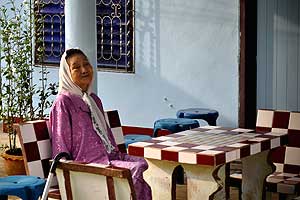 Abdullah married Suriani in 1955 and they have a daughter named Karimas who is now 53.
The number of his comrades stood at about 260 when the peace deal was inked and now it has dwindled to less than 20. Some have returned to Malaysia while others have left the village but most of them have died.
The average age of his comrades is about 80 - Abdullah and his wife are the oldest with both being 85.
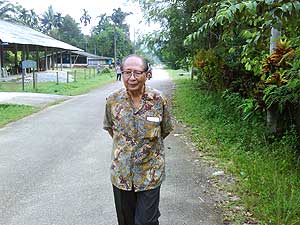 Old age has slowed down both of them, both physically and mentally, with Suriani suffering for the worse.
As for Abdullah, he is physically capable of still having a walk around the village every morning but he tends to forget things quite easily. His memory also has the habit of failing him regularly.
Nothing gives him more joy however than reminiscing about the "good-old days when we fought against the enemies".
"We had so many good fights. We gave them as good as we received. Many people died from both sides but we were fighting for a cause," he said with his ever-ready laughter. He also has the habit of slapping his thigh whenever he makes a point.
Abdullah played a vital role in the 1989 peace deal. It was he who made contact with the then deputy prime minister Ghafar Baba to initiate talks.
A few months later, he joined his comrades Chin Peng and Rashid Maidin in signing the peace agreement on behalf of CPM.
Since then, their base camp which was located in the Thailand side of the border has become their village. The villagers - former communists, their families and extended families - are a close knit group.
Although they have a village administrative set up, Abdullah and Suriani are given the honour of being the village elders who have a say in everything that takes place in the village.
Preparing for life after Abdullah
However, the fear is now creeping among the villagers, especially the second generation communist villagers, on what the future will hold without Abdullah and Suriani.
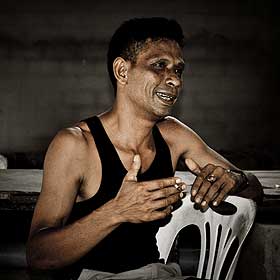 "We have to be prepared for the worst. They have been our guiding lights all this while. Without them it will be difficult but I think we can manage," said village head and former communist fighter Dome Za (
left
), a Malay-speaking Thai.
"We have to be prepared for the worst. They have been our guiding lights all this while. Without them it will be difficult but I think we can manage," said village head and former communist fighter Dome Za (
left
), a Malay-speaking Thai.
The real fear, however, is whether the strong discipline practiced by the villagers, due to years of training for war in the jungle, will dissipate with the passing of Abdullah and Suriani.
The villagers revere Abdullah and his wife, there's no doubt about it. For them they are legendary figures, especially Abdullah who had cheated death twice during the war years.
Abdullah was involved in many armed battles with the British forces and in one such confrontation, he had suffered serious injuries from a hand grenade explosion and it took him weeks to recover from that incident.
 He suffered his worst fate when he was poisoned by an infiltrator in 1975. It took him many months to be fully fit-for-war again. His loyalists claim that Abdullah is still suffering the after-effects of the poisoning.
Abdullah in his memoirs - he has written a three-part memoir - has thanked Suriani for keeping him alive after being poisoned.
The genial patriarch is full of high praises for her.
"She offered advice and shared her thoughts with me during our Long March in 1953-54. Her views helped me in my efforts to move the army to the border safely.
"For half a century we struggled together, fought a war together, laughed and cried together, worked hard to be of service to the struggle, expanded and developed Regiment 10 until the guerrilla struggle ended in December 1989," he wrote.
No plans to return
Even today, the bond between Abdullah and Suriani is visibly strong.
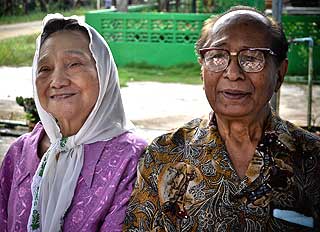 They spend their evenings together sitting at the verandah of their house, mostly talking about their memories of the war years.
They have visited Malaysia on a number of occasions after the 1989 peace agreement.
When asked if he has the intention of returning to Malaysia for good, Abdullah took awhile to answer.
"It's better to remain here in Thailand. Our contributions for Malaysia are immense but we are not properly recognised. For them we are terrorists, not freedom fighters," he said.
He also added that there were too many security laws in Malaysia, alluding to the fact that he could still be arrested for being a ‘national threat'.
"They still have the ISA and other security laws," he concluded with a loud guffaw and trademark slap of the thigh.
RELATED STORIES
Deleted from victors' history: The other freedom fighters


