




Man-made disaster threatens Semariang
More than 150 low-income Malay families in Bandar Baru Semariang, a suburb of Kuching, face being thrown out from their low-cost homes. The Sarawak government says they have defaulted on loan repayments for six months.
This community is still recovering from a storm that swept through their neighbourhood on June 15, ripping the roofs off dozens of houses. But there was worse to come.
More than 150 low-income Malay families in Bandar Baru Semariang, a suburb of Kuching, face being thrown out from their low-cost homes. The Sarawak government says they have defaulted on loan repayments for six months.
This community is still recovering from a storm that swept through their neighbourhood on June 15, ripping the roofs off dozens of houses. But there was worse to come.
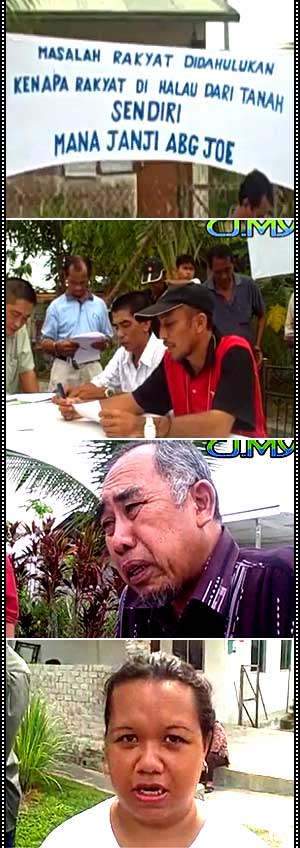 The Housing Development Corporation (HDC) has decided to evict these poor families, creating a man-made disaster that threatens to deprive them of a roof over their head.
Pak Ali, a 59-year-old resident, said: “We have just received notice from the HDC, demanding that we pay up every single sen of our monthly housing instalment arrears within 14 days, failing which we will be evicted. An officer said the same notice will be served on more than 150 families.”
The notice of eviction was also posted in a local English-language daily.
The estate was built for the HDC by Cahaya Mata Sarawak (CMS), a conglomerate controlled by Chief Minister Abdul Taib Mahmud’s family. The low-cost houses are a small part of the Bandar Baru Semariang project.
The entire township, targeted at the middle class market, is the largest in the CMS Property Development’s stable. It is ‘considered a landmark project for the company’, according to its website .
The HDC was a state statutory body from 1972 until it was corporatised in 2003. Its mission statement is “to build affordable quality homes for the rakyat, especially the low income group”.
State Housing Minister and HDC chairperson Abang Johari Tun Openg had held a dialogue on Sept 18 last year with the Semariang community, to negotiate unpaid HDC home loan instalments.
State changes tune
Abang Johari promised that the Sarawak government would restructure the loan repayment period if the house owners are in dire financial straits. He claimed that the HDC was willing to listen to them and discuss means to solve their problems.
"The bottom line is, they must pay, otherwise the matter will be brought up at the state legislative assembly sitting, as to why no efforts (have been made) to track down the owners and collect the debts.”
 Following the dialogue, Abang Johari dismissed the loan default as a “small problem” and “not serious”, according to a
Bernama
report.
Following the dialogue, Abang Johari dismissed the loan default as a “small problem” and “not serious”, according to a
Bernama
report.
His tone was very different when he answered reporters’ questions on the threatened evictions on July 27. He blamed the house owners for “poor management of income”.
He claimed they used their income to pay for “monthly instalments on their vehicles, subscription (fees for) cable television and hand-phones”.
Retorted an elderly resident: “Abang Jo has no knowledge of our difficulties. The only time we were able to bring him to our dialogue with the HDC, he quickly delivered his speech and ran…saying that he needed to attend a wedding. The HDC officials then hastily called off the dialogue because they did not know what to do with us.”
Yasin, another resident, added: “Some families have bought a Kancil, but that is to get them to work and to send their children to school. Most would provide a ride for their relatives and friends to share the burden of fuel expenses and car loans. The Kancil is a necessity, not a luxury.
“Abang Jo is chauffeur-driven in his Mercedes, so are his children. I don’t think he understands our dilemma.
“The Astro satellite dishes are deceiving. Many of us signed up when Astro offered us free installation and equipment. However, we didn’t get to watch the programmes for long, as we could not keep up with the monthly subscriptions. The satellite dishes are there just because nobody bothers to take them down.”
‘Houses built like animal pens’
A visit to the low-cost housing scheme yields a pitiless vista of dry cracked roads and shoddy houses. The walls are thin, the ceilings are low and the small yards are bare. One small house has a partially collapsed wall.
A few families try gamely to beautify their tiny plots with green plants and bright flowers. Children play in the baking sun.
Telekom Malaysia has not provided telephone services, although the estate is only 7km north of Kuching. The public transportation system is abysmal. The urban Malay poor here have been isolated, but they are proud to own their own homes, instead of living as squatters.
The storm on June 15 brought untold hardship to this under-privileged community. It damaged 89 houses, with 41 badly hit. Abang Johari said the HDC would pay for repairs for 34 of the worst-hit houses, while CMS would pay for the remaining seven.
Abang Johari, after inspecting the devastation, said: “It has nothing to do with the structure of the houses because the other houses are intact. It is just unfortunate that the roofs of the houses were blown away in the storm.”
‘Pengundi Alaf Baru’, a visitor to the blog of the Petra Jaya member of parliament, alleged that “CMS built the houses like animal pens”. He asked angrily why both the roofs and ceilings of houses were blown away together during storm. He pointed out there was no truss or beam to keep the roofs intact.
Azahari Sahari, the Semariang Residents’ Action Committee chairperson made a public call on July 25 for the eviction notice to be withdrawn and for the loan period to be extended.
“Locking up the houses and kicking out the families is an inhumane action,” he said.
However, it is clear that being ‘humane’ is not one of the corporate values stated on the HDC’s website.
Azahari also urged the government to examine the safety of the houses, saying the structure is not sound. He pointed at walls that had crumbled within five years of construction, and at unsafe electrical wiring.
 See Chee How, a lawyer for the residents, said: “I am troubled by the fact that these poor people are victims of corruption, nepotism and political manipulation.”
He called on the HDC to stop the threat of forced evictions and to re-negotiate the loan payment schedule.
For home-owners in Sarawak – Iban, Penan, Bidayuh or Malay – the security of their homes and of land tenure remains elusive.
Rural communities have set up blockades of timber roads throughout the state, in a desperate attempt to defend their ancestral lands from timber and oil palm companies.
Mega-projects like the Bengoh Dam in Padawan, and the Murum Dam, deep in the interior of the Rejang region, threaten the ancestral lands and homes of thousands of native Sarawakians.
The massive profits for these projects remain in the hands of a few members of the political elite.
In these rural areas, people live in continual fear of losing their homes, as in urban Semariang. It is obvious that money talks and people listen – but the poor have no voice.
KERUAH USIT is a human rights activist - anak Sarawak, bangsa Malaysia . His 'The Antidote' column, which appears in Malaysiakini every Wednesday, is an attempt to allow the voices of marginalised people to be heard all over Malaysia.


