




The English dilemma
After many months of very intense debate in the mainstream and alternative media, Deputy Prime Minister Muhyiddin Yassin, who is also education minister, has finally announced the government decision to reverse the teaching of math and science from English to Bahasa Malaysia and the vernacular mother tongues.
The decision is not likely to please everybody, and the debate is sure to rage for years to come. After all, it is an issue that affects all parents in the country.
On his blog, Dr Mahathir Mohamad has conducted a poll to survey public opinion on the matter. About 72 percent of the respondents are against the government decision. But then, the teaching of math and science in English was the brainchild of this former prime minister, and the recent reversal by the current government can only be seen by him as a betrayal of his personal legacy.
After many months of very intense debate in the mainstream and alternative media, Deputy Prime Minister Muhyiddin Yassin, who is also education minister, has finally announced the government decision to reverse the teaching of math and science from English to Bahasa Malaysia and the vernacular mother tongues.
The decision is not likely to please everybody, and the debate is sure to rage for years to come. After all, it is an issue that affects all parents in the country.
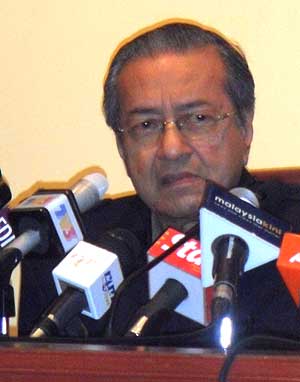 On his blog, Dr Mahathir Mohamad has conducted a poll to survey public opinion on the matter.
About 72 percent of the respondents are against the government decision. But then, the teaching of math and science in English was the brainchild of this former prime minister, and the recent reversal by the current government can only be seen by him as a betrayal of his personal legacy.
The glaring question is: will Mahathir now train his sight on the current Prime Minister Najib Abdul Razak, as he did with Abdullah Ahmad Badawi?
Many commentators have pointed out that the government flip-flop on the issue is a direct concession made to the linguistic nationalists from all ethnic communities in Malaysia.
Personally, I have a great deal of sympathy with the linguistic nationalists of all shades. I am partly the product of the Chinese primary school system, and until today, I still do multiplication in my heart in Mandarin, even when I have to work on a problem in quantum physics.
I am also a product of the old all-English education in the 1960s when we had to sit for examinations administered by Cambridge overseas certificate board. After I finished Form Six in 1968, I taught English as a compulsory subject in Form Five classes to prepare them for the Cambridge Overseas Certificate exam with some success. My best students were those transferred from Chinese schools.
The blind cannot lead the blind
Those parents who want to have math and science taught to their children in English argue from the pragmatic point of English being the premier language of commerce, scholarship, and diplomacy. Mastering the English language will equip their children with an added edge on the job market when they grow up.
I agree that mastering the English language is important for all Malaysians, for reasons beyond those expressed by many parents. But the best way of learning a foreign language is not by teaching it in math and science classes, especially when the English proficiency of all our math and science teachers must be suspect. The blind cannot lead the blind.
The best way to learn any foreign language is through total immersion in the language, using it all day long in daily life, preferably among native speakers. That is how all those foreign students from all over the world learned their English in the Canadian universities I attended in the 1970s.
Failing that, the second best way to learn a foreign language is to teach it as a single compulsory subject in schools - from the primary to the university level.
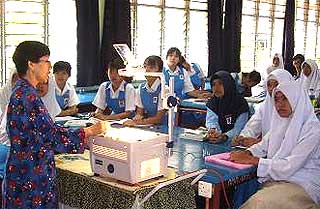 When I went to Stockholm in Sweden for an international meeting once, I was surprised that all the young Swedes spoke English fluently, though with a heavy Swedish accent. I was told that English was taught as a second language throughout their school days.
To improve the teaching and learning of our school children, the whole system of the current way of doing things must be reformed.
The entire curriculum must be overhauled. All this talk about teaching modules may be fashionable; it is also in vogue to say how learning any language should be made fun.
The truth of the matter is that English is not an easy language to master. The basic rules of grammar, syntax, and parts of speech simply cannot be grasped as a kind of second nature without long years of much rote learning and repetitive weekly exercises.
Spelling, vocabulary, and pronunciation simply cannot be learned without weekly spelling and dictation tests. Comprehension, reading and writing skills simply cannot be mastered without weekly tests in précis and essay writing. Multiple-choice questions and matching terms will not do the tricks.
Teachers who don’t know Jane Austen
The Achilles’ heel in our nation’s current educational system must be the shortage of qualified teachers who are proficient in English themselves. The really competent ones would have gone in search of their pot of gold in the highly lucrative private tuition industry.
I had to interview some applicants for teaching English for a tuition centre once in KL. Quite a few had a diploma in teaching English as a second language from Universiti Malaya. Their handle on the language was so obviously inadequate. None of them had heard of Jane Austen!
We have until 2012 before the new policy is put in place. If the government is serious about raising the standard of English among our future citizens, then it is imperative to improve our teacher-training programmes, in the universities and our teacher training colleges.
Native speakers of the English language with the highest academic qualifications must be recruited from overseas to teach these future teachers of the language in our country. Here, we must repress the impulse of the New Economic Policy to push through mediocre graduates. Instead, there must make serious efforts to recruit and pass only the best students, irrespective of race.
Current teachers can also be given intensive refresher course. What is more important though is perhaps a concerted effort to stock up the library in educational institutions at all levels.
Dedicated English teachers must be encouraged to start English drama clubs, English speech-and-debate contests, and English school magazines. Parents must allow their children to participate in these extra-curricular activities, rather than filling all their free time with more regimented English tuition classes.
I still think that the best way to learn English is through the teaching of English literature as an optional subject from a very young age, starting with nursery rhymes and fairy tales, graduating slowly to the great classics.
The love of literature so nurtured will encourage students to want to read on their own in their free time. Ultimately, reading a great deal of English books is the surest way of acquiring English proficiency through a process of mental osmosis.
The teaching of the English language is essentially an educational issue, but unfortunately for Malaysia, the language issue has always been infused with too much political fervour.
The current furore nascent in the national conversation on the subject is the result of a faulty system of decision making. Policy decisions are made always at the power centre from the top down, without much consultation with parents and teachers, who are the real stakeholders in these matters.
As long as education is deemed to be a tool for social engineering within the political agenda of the ruling class, decision-making will not be decentralised and deregulated, leaving little room for public participation from the local community.
What is needed to resolve this, and many other controversies, is a major political reform in the political structure of our country.
SIM KWANG YANG was MP for Bandar Kuching from 1982 to 1995. He has spend many years as an educator. Sim can be reached at kenyalang578@hotmail.com.


