




Sabah opposition at odds over poll pact
The fledging opposition in Sabah has accepted “the over-riding principle of one-to-one against the might of the ruling BN” in the next general election, according to a PKR leader. However, the various parties in the opposition are yet to discuss any allocation of seats among themselves.
The fledging opposition in Sabah has accepted “the over-riding principle of one-to-one against the might of the ruling BN” in the next general election, according to a PKR leader. However, the various parties in the opposition are yet to discuss any allocation of seats among themselves.
“It’s premature to talk about allocation of seats,” said PKR vice-president Jeffrey Kitingan in qualifying a statement yesterday on the matter raised by Kota Kinabalu MP Hiew King Cheu from DAP.
“Perhaps, he’s just testing the waters but why he should do this at this juncture is indeed puzzling. It’s still early days. Besides, any decision would be made collectively and not by any one person issuing a statement in the media.”
 Kitingan reiterated that the allocation of seats was not discussed at all during the recent maiden visit to the state by Sabah PKR chief Azmin Ali.
He said that he could not be present at the luncheon where, according to Hiew himself, the allocation of seats was not raised by Sabah People’s Progressive Party (Sapp) leaders “but I am privy to what happened”. Kitingan was away in Tambunan to visit his aging mother.
Kitingan begged to disagree with Hiew’s “negative line” that it would be pointless for the Pakatan Rakyat to pursue an electoral pact with Sapp.
 Hiew (
left
) bases his rationale on “Sapp thinking along the lines of Sapp-Plus and not Pakatan-Plus as advocated by DAP elder Lim Kit Siang last year”. This was when the Sabah party decided to stay out of the opposition alliance.
Hiew (
left
) bases his rationale on “Sapp thinking along the lines of Sapp-Plus and not Pakatan-Plus as advocated by DAP elder Lim Kit Siang last year”. This was when the Sabah party decided to stay out of the opposition alliance.
“In fact, I can say that cooperation between Sapp and Pakatan is excellent. They do know who is the common enemy,” said Kitingan in a thinly-veiled reference to the BN.
“Ultimately, who contests where will depend on the respective strengths and weaknesses of every party in the opposition. We have to be practical in matters like this. It wouldn’t pay to indulge in wishful thinking and living on hopes. We should not do things in such a way that the people will laugh at us (the opposition) after the polls are over.”
Whatever the approach adopted to take on the might of the BN in Sabah, Kitingan said “the strong will have to help out with the weak everywhere subject to the principle that a seat should go to the person who has the best chance of success”.
Sapp’s big ambition in Sabah
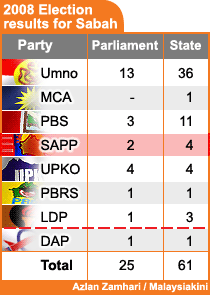
Hiew’s line is that Sapp, being a home-brewed party, would want to contest between 45 to 50 of the 61 state seats. He did not mention how Sapp wants the parliamentary seats to be divided.
 He claimed that he had had numerous discussions with Sapp leaders who apparently made known their feelings on the matter to him. This was quite some time ago, he conceded, but thinks the situation has not changed since then.
“I know that Hiew was quite close to Sapp leaders up to the time of the last general election when he won the Kota Kinabalu parliamentary seat under a DAP ticket,” said Kitingan.
“But I honestly don’t know whether this is still the case. Sapp quitting the BN last year and joining the opposition has changed the entire political and electoral scenario in the state.
“Whether Hiew has since fallen out with Sapp leaders is something that I can’t say for sure. But I wouldn’t be surprised because of the changed circumstances.”
PKR vice-president declined to delve into Hiew’s argument that the 60 state seats would be divided between PKR and DAP with the latter contesting about 25 seats - most of the 10 urban Chinese.
“That is perhaps their wishlist. In that case, what about PAS? asked Kitingan. “PAS is also in Pakatan. We can’t leave them out in Sabah.”
Hiew’s wishlist doesn’t quite jell either with PKR Tuaran division chief Ansari Abdullah’s observation that only the urban Chinese and the middle-aged bumiputera are at the moment with the opposition in Sabah.
He sees the young voters as easily rattled by any threats leveled at their future but Kitingan however sees them as fence-sitters who are leaning more towards change.
Given the prognosis between Ansari and Kitingan, the implication is that DAP would need Sapp’s help if it is to put in a credible performance at the polls even in the urban Chinese seats allocated to them.
Hence, the question of “an imported party” like Sabah DAP taking all or the lion’s share of the urban Chinese seats does not arise at all, while the bumiputera seats “are certainly not for their taking” even if Pakatan and Sapp leaders were inclined to allot some to them.


