




Lee Kuan Yew's Malaysia complex
More than a week after Singapore's Minister Mentor Lee Kuan Yew had visited Malaysia, Dr Mahathir Mohamad remains bitter. In his blog entry, the former prime minister ridicules the passage of a bill in the island state that defines one person as an assembly.
More than a week after Singapore's Minister Mentor Lee Kuan Yew had visited Malaysia, Dr Mahathir Mohamad remains bitter. In his blog entry, the former prime minister ridicules the passage of a bill in the island state that defines one person as an assembly.
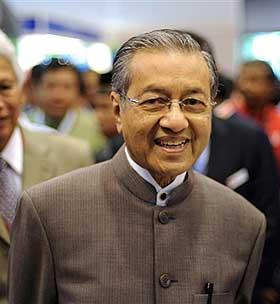 Mahathir's intention is clear: hold Lee in high regard if you want to, but who between us is the more merciless despot?
I do not dispute the fact that Lee and his son Lee Hsien Loong govern Singapore with an iron fist, but it still does not justify the 22 years of autocratic rule by Mahathir.
The Lee dynasty has indeed subjected the entire republic to political tutelage, but at least it has succeeded in making the 'little red dot' a financial hub and among the most competitive economies in the world, and the rest of Southeast Asia can only watch with a jaundiced eye.
Mahathir should stop being obsessed with his own ego and jealousy, and seek to understand why he has failed to create in Malaysia public institutions that are clean, efficient and sustainable despite our rich natural resources.
When Mahathir took over the prime ministership in 1981, Singapore was still a developing nation. Today, the average income of Singaporeans is four times that of Malaysians, while the ringgit, once at par with the Singapore dollar, continues to slide.
Anyway, the purpose of this article is not to make a comparison between the two octogenarian autocrats, but to psychoanalyze Lee in the wake of his extended visit to Malaysia.
A self-assured and overweening man, Lee never settles for the second best. In his memoirs T he Singapore Story , he details how he managed to persuade Cambridge University to take him in as a law student although he had been offered to read law at the prestigious London School of Economics. Considering himself an Oxbridge material, Lee eventually graduated with a double First Class Honours and a star for "special distinction".
After Lee became the first officially elected prime minister of Singapore, he began to work in earnest towards a political union with Malaya, seeing it as a hinterland for the island. But his refusal to play second fiddle to Tunku Abdul Rahman and other Umno bigwigs, coupled with the hidden competition between him and Tan Siew Sin of the MCA for the Chinese vote made him the most annoying counterpart to deal with.
'I divorce thee'
After Malaysia was finally founded in September 1963, the Tunku was pleased with the new racial equilibrium, and Lee saw the vast and resource-rich territories of Sabah and Sarawak as the springboard for his political ambitions.
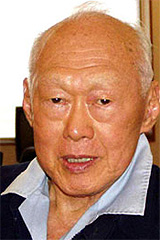 Lee most probably set his sights on the highest political office in Malaysia.
In launching the 'Malaysian Malaysia' campaign, he was dropping hints that the country could one day be led by a non-Malay. Little wonder that the Tunku and his underlings were alarmed. Too bad, that Lee took the Tunku's debonair character for granted and underestimated his rivals.
In relating the painful experience of Singapore being expelled from Malaysia in his memoirs, Lee used 'Talak, Talak, Talak (I Divorce Thee)' – the Islamic phrase used in divorce - as the title for the chapter. It sums up the shock and anguish that Lee felt at the time, while the abrupt end of the political union effectively severed Singapore's ties with Sabah and Sarawak, something that Lee came to regret rather deeply.
Singapore's expulsion being his biggest political setback, it is hence understandable that Lee continues to demonstrate complex feelings towards Malaysia.
The paramount leader is anxious to emphasise Singapore as a sovereign nation, yet he comments rather freely and enthusiastically on Malaysian politics whenever permissible, as if his country had never ceased to be a part of the federation.
Lee's emotional detachment is clear for all to see even when he talks about China, but his temperaments immediately change whenever Malaysia is mentioned.
One should not be easily deceived by the ostensible differences between Singapore and Malaysia, for the ruling ideologies of the two governments converge more than they diverge. Politically, both the People's Action Party (PAP) and Barisan Nasional subscribe to the instrumentalist argument that only a strong and stable government can ensure economic development and social harmony. In other words, they both see multiparty elections and genuine democratic participation as a unnecessary drain on public monies.
In their understanding, a formidable opposition has the potential to threaten national security and bring about social unrest. It is therefore intriguing to see Lee advise the Pakatan-ruled states to work more closely with the BN without commenting on the attempt by the federal authorities to frustrate those states in exercising their mandate to rule.
In terms of multiculturalism, the PAP and Umno are remarkably similar in their worldviews. They both seek to micromanage the languages and cultures of various communities, turning them into an ethnic 'boutique' for international consumption. When one ethnic group presses for greater autonomy and steps over the boundary set by the state, it is chastised for 'obstructing social unity' in no time.
The only difference is that, under Lee's rule, a once vibrant and bourgeoning Chinese education died a natural death, while Chinese schools in Malaysia have seen an amazing revival since the 1980s. Mahathir pales into insignificance when compared to Lee's high-handedness in cracking down on 'Chinese chauvinists'. That Lee had not requested to meet with the leading Chinese educationists during his eight-day stay was not a coincidence.
Given that Lee was even resolved to do away with Chinese schools, it was no surprise that the non-Chinese in Singapore were grudging stomaching the implementation of English as the first language. Here in Malaysia, Umno is seen as constantly advancing its ethno-nationalist agenda at the expense of others.
'Quality authoritarianism'
In other words, the social consensus in Singapore was that the non-Chinese were prepared to tolerate Chinese leadership so long as the state remained neutral in the issues of race, culture and language.
Things however began to change in the late 1970s and the 1980s when the PAP government launched the Speak Mandarin campaign and allowed more Chinese from Hong Kong, China and Taiwan to reside in Singapore.
Lily Zubaidah Rahim is the daughter of Abdul Rahim Ishak, the first president of the Republic of Singapore. Alarmed by the changing demographic landscape, she chose to vote with her feet and is now a resident of Australia.
 In her seminal book
The Singapore Dilemma: the Political and Educational Marginality of the Malay Community
, she articulates forcefully the betrayal that a certain segment of the Malay community in Singapore felt about the increasingly 'sinicization' of the island state.
In her seminal book
The Singapore Dilemma: the Political and Educational Marginality of the Malay Community
, she articulates forcefully the betrayal that a certain segment of the Malay community in Singapore felt about the increasingly 'sinicization' of the island state.
What is not clear, however, is whether her argument was made out of a genuine concern over the loss of Malay identity and the bleak future of the Malay language in Singapore, or was it simply a psychological response to the presence of more Chinese in the country. After all, being a member of the English-educated social elite, Lily and her peers may not care that much about the long-term development of Malay education so long as their position was secure.
Some of the PAP developmentalist views are questionable. When Ng Eng Hen, Singapore's minister of education, sighed at the lack of high-rise buildings in PAS-ruled Kota Bahru, it only laid bare his superficial infatuation with the tallest, biggest and longest, as well as his failure to make sense of Malaysia's vastness in size and regional diversity.
Some describe Lee's leadership style as 'quality authoritarianism', a unique synergy of democratic impotence and economic prowess that continues to amaze other autocracies such as China. I often wonder if Umno had succeeded in modeling on Lee’s authoritarian-capitalist regime and producing economic efficiency, would we have witnessed the rising support for the Pakatan today? And what fate would have befallen the vernacular schools?
Even Lee himself would be keen to have his political ideals fully accepted by Malaysia. Vindicated, the ex-Malaysian would be having the last laugh from beyond the grave.


