




Obama and Asean: a new dawn?
In her testimony to Congress on her confirmation as Secretary of State in January this year, Hilary Clinton broached the idea of the United States as a "smart power", and set out several guiding principles in achieving Washington's foreign policy goals.
First, she would combine America's economic and military strengths to entice, rather than coerce, other countries to work with the White House in resolving international issues.
In her testimony to Congress on her confirmation as Secretary of State in January this year, Hilary Clinton broached the idea of the United States as a "smart power", and set out several guiding principles in achieving Washington's foreign policy goals.
First, she would combine America's economic and military strengths to entice, rather than coerce, other countries to work with the White House in resolving international issues.
In other words, diplomacy would take precedence over head-on confrontation under the Obama administration.
Secondly, US diplomacy would be based on pragmatism instead of abstract concept of national interests, which had caused serious loss of trust in the US by the global community when President Bush was in charge.
Finally, Clinton promised to communicate and consult more with the rest of the world.
Not long after the confirmation, she went on a tour to several important Muslim nations, Indonesia being one of them.
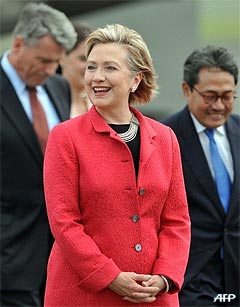 In doing so, Clinton
(right)
made herself the first Secretary of State to visit the world's largest Muslim country within three months of taking office, something that delighted the Indonesians greatly.
In doing so, Clinton
(right)
made herself the first Secretary of State to visit the world's largest Muslim country within three months of taking office, something that delighted the Indonesians greatly.
The choice of Indonesia was a cautious and informed decision: President Obama knew he had to repair the severely damaged relationship with the Muslim world, and that US-Asean relations, practically neglected during the Bush years, had to be revitalised.
According to Robert Gelbard, former US ambassador to Jakarta, Obama was determined to pay more attention to the Asean giant because it was where the will of the people was.
In fact, there cannot be a better strategy than greater and constructive engagement with Indonesia. It is the most populous Muslim country as well as the most vibrant democracy in Southeast Asia.
Who said democracy did not sit well with Islam, and who believed freedom could only be imposed on the Muslims by force as has been the case in Iraq? Obama has clearly been deconstructing Bush's antagonistic strategies.
That the Bush administration had very little regard for the Asean Regional Forum (ARF) is no secret. While Asean countries see the ARF as a security mechanism with which to collectively respond to regional crises, Bush mostly used it to canvass support for US positions on North Korea, Myanmar, Iran's nuclear programmes and even the Iraq problem in the early 2000s.
Making good promises
When the White House could not get its own way, as was the case in 2007 over the Myanmar issue, Condoleezza Rice slighted the annual consultation by skipping it altogether, sending a very negative message to the regional countries.
While Obama and Clinton are ready to make good their campaign promise on Southeast Asia, that is to "assure that the US is fully and appropriately engaged in current institutions, such as Asean and APEC, and explore enhanced collaboration to new and non-traditional threats", it is no disguise that one of the central pillars of this new approach remains the challenge of radical Islam.
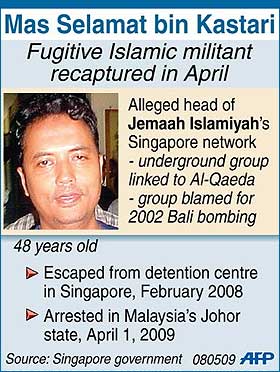 After all, Southeast Asia is a key area when it comes to dealing with terrorist threats. When the Malaysian authorities nabbed Mas Selamat
(left)
Kasturi, one of the most wanted fugitives in the region, Indonesia, Singapore and the US were extremely relieved.
After all, Southeast Asia is a key area when it comes to dealing with terrorist threats. When the Malaysian authorities nabbed Mas Selamat
(left)
Kasturi, one of the most wanted fugitives in the region, Indonesia, Singapore and the US were extremely relieved.
It again indicates Malaysia's strategic importance and this is something that Obama's policy advisors will take note of in addition to placing emphasis on US-Indonesian ties.
What distinguishes Obama's strategy towards Southeast Asia from that of his predecessor is his recognition of Muslims taking a central role in regional affairs.
Instead of seeing the "Islamic belt" of Indonesia, Malaysia, southern Thailand and southern Philippines as a threat, as was the case over the past several years, the White House is ready to acknowledge Islam being an essential component in the region's political development, as testified by the free, fair and highly competitive of electoral politics in Indonesia.
The recent ideological tussles within PAS in Malaysia must also have impressed the Obama administration, ditching the stereotype of Islamic politics as monolithic and ultra-conservative.
In giving greater and positive value to the diversity in Islamic politics, both Obama and Clinton indicate a clear and mature policy shift away from the Us vs Them dichotomy under Bush.
Still, as far as the US is concerned, a fundamental purpose in restoring ties with Southeast Asia is to ensure continued and smooth access to the region, diplomatically, economically as well as militarily, Washington's military cooperation with Singapore, the Philippines and Thailand being a case in point.
Even with Indonesia, the US has made substantive progress since Susilo Bambang Yudhoyono became president in 2004, and it is inconceivable that the vastly improved military ties will be reversed under the more sensible Obama administration.
The Indonesians are also pleased to know that their country has moved from being perceived by the Bush government to be the weakest link in regional terrorism to being now acknowledged as "primus inter pares": first among the equals.
In view of The Malacca Strait being a vitally important sea-lane, the mercurial North Korea as well as the occasional tensions between China and Taiwan, it is also rather unlikely that the US would sit idly by should things turn sour. A closer partnership with Asean would also mean that the US as a "smart partner" could be used by the region to hedge against China's rising influence, thereby increasing the grouping's bargaining chip.
All this would naturally entail a potential clash with Beijing's interests, a topic that I will discuss next.


