




Uphill task to save Sabah's 'rarest animal'
Poaching, reluctant mating habits, in-breeding, the scorching tropical heat and the lack of funds for conservation are all working together in an unholy combination to wipe out the last of Sabah’s Borneon Rhino.
Poaching, reluctant mating habits, in-breeding, the scorching tropical heat and the lack of funds for conservation are all working together in an unholy combination to wipe out the last of Sabah’s Borneon Rhino.
The rhinos, Dicerorhinus sumatrensis harrissoni , are found mostly in the Tabin Wildlife Reserve in Lahad Datu, along the state's east coast.
The reserve is the last remaining refuge for this Sumatran Rhino sub-species, the world’s most endangered, in the whole of Borneo.
Now, a last-ditch effort is being made by the newly-revamped Borneo Rhino Alliance (Bora), formerly the SOS Rhino Borneo, to save the remaining 30 heads in Borneo.
About 15 of this endangered animal have been tracked in Tabin and the rest in the Danum Valley Conservation Area, or as scattered isolated individuals.
There are no rhinos in Sarawak and Brunei and no footprints have been sighted for years in Kalimantan, on the other side of the difficult mountainous watershed boundary that divides the Malaysia and Indonesian halves of Borneo.
Worldwide, their numbers are less than 200, according to State Minister of Tourism, Culture and Environment Masidi Manjun, who has thrown the state government’s efforts behind the drive to save their dwindling numbers in Sabah.
Apparently, Bora will play a key role in the creation of the proposed Borneo Rhino Sanctuary in Tabin.
Isolated rhinos from elsewhere in Sabah will be brought into a large fenced 5,000 hectare sanctuary of natural forest, a semi-captive programme, to boost their prospects for breeding and reduce the threat of poaching.
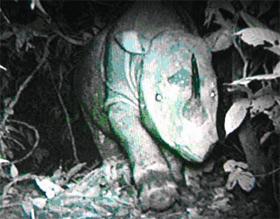 Bora member Dr John Payne, also senior technical advisor to WWF-Malaysia in Sabah, points out that ‘slow breeding’ where the rhino takes up to 15 to 16 months of pregnancy and only have an offspring every three to five years, is part of the problem in saving the animal.
Rhinos are generally solitary animals that only come together to breed. Gestation is 475 days with one calf per birth. Captive rhinos live to around 35 years.
“We are hoping to set up a nucleus for the animals to breed. Though we are not sure how much land per rhino needs, our best guess is about six animals for the sanctuary,” said Payne.
The Tabin Sanctuary will be a renewed attempt at saving the animal as against the alternative of tamely giving up on the species and letting them go extinct.
However, the future of the animal is by no means secure despite the protection of the 120,000 hectare Tabin Wildlife Reserve.
Penans stalking the animals
The rhino is found in a wide variety of habitats, from lowland rainforests and swamps to mountain moss forests.
It seems to prefer hilly areas near water, particularly steep upper valleys with thick undergrowth, as well as secondary forest where the upper canopy is broken and the smaller shrubs and vines which it feeds on are more plentiful.
The rhino moves seasonally, staying in hilly country when the lowlands are flooded during the rains, descending when the weather has become cool near the end of the rains, and returning to high ground.
The rhino can climb up and down steep slopes with great agility. It swims well and has been known to swim in the sea. Males are usually solitary, while females are found in mother-offspring groups.
If Sarawak is free of the rhino, it is because the forest-dwelling Penans stalked the animals from behind, following their tracks, and simply cut them down with swords for the meat as well the horns which fetched good money from Chinese traders who swear that the powdered form was a good fever-reducing agent and not so much an aphrodisiac as it is widely believed.
Money remains the central problem for bio-patriots despite a fund-raising Rhino Rescue Lunch in mid-March in Kota Kinabalu which netted just over RM500,000 from the general public and corporations.
The Sabah government thinks the Borneon Rhino is worth saving, if for nothing else, but the tourist dollar that it can help bring in.
“Tourism is the biggest driver of growth in Sabah as people come here to see things or animals they cannot see anywhere else in the world,” said Masidi.
“Sabah is still going strong in tourism, despite a drop worldwide, because we are aware of the importance of conservation.”


