




UPM = Universiti Paling Malu?
University Putra Malaysia vice-chancellor Professor Dr Nik Mustapha R Abdullah must have offended many groups with his decision not to act against students who led a recent fracas - other students, Malaysians who hold budaya budi to be sacrosanct, civil society groups, and probably Chinese groups as well.
But his decision is likely to have delighted quarters in this country that thrive on a culture of impunity.
This culture has twisted our rallying cry of Malaysia Boleh to earn our country the scathing moniker of Bolehland - the land where you can get away with anything, even when the evidence is conclusive and damning.
University Putra Malaysia vice-chancellor Professor Dr Nik Mustapha R Abdullah must have offended many groups with his decision not to act against students who led a recent fracas - other students, Malaysians who hold budaya budi to be sacrosanct, civil society groups, and probably Chinese groups as well.
But his decision is likely to have delighted quarters in this country that thrive on a culture of impunity.
This culture has twisted our rallying cry of Malaysia Boleh to earn our country the scathing moniker of Bolehland - the land where you can get away with anything, even when the evidence is conclusive and damning.
It is evidence indeed that is at the heart of this matter. This entire incident would have barely made the news at all if not for the individual with the presence of mind to videotape the proceedings in its disturbing entirety.
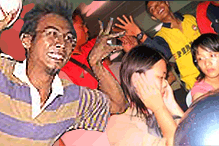 Many of us desperately hoped that the strength of such incontrovertible evidence and its wide circulation on the Internet would finally destroy any barriers to the march of justice. In short, we have had our hearts broken, our ideals nearly crushed and our faith in the country we love severely tested.
Nik Mustapha has offered explanations for his judgment that would be considered ludicrous and unbecoming of an academic, and grounds for resignation or dismissal in the developed countries with their First World mentality to which we are encouraged to aspire.
His entire rationale appears to rest on his twisted belief that the video is "subject to interpretation" as he was quoted as saying. I disagree; interpretation is the domain of legal documents or Shakespeare poems, not videotaped incidents such as we have seen.
Shallow understanding
The vice-chancellor's interpretation is that the offending students were not in fact heckling or harassing the other students but were rather, and I quote the malaysiakini report: "merely singing and cheering, and not shouting".
I would also refer you to the report of the UPM inquiry committee that probed this incident, but for reasons unknown to us mortals, which has been classified (national security at risk, perhaps). This comes despite Nik Mustapha's insistence that the investigation was done in a "transparent and fair manner". How can something be transparent if no one can see it?
Still, we should always afford the benefit of the doubt. Perhaps that's just a very odd hostel song and the poor students who were being 'sung' at simply misunderstood the 'cheerful' intentions of the other party. I am not qualified to comment on the recreational choir practices of UPM students. [See video]
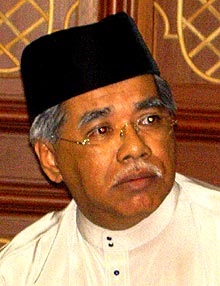 Nik Mustapha goes on to say that no violence was in fact committed and that one group of students were "only threatening" the other. Furthermore,
The Star
quoted him as saying that the incident "happened in the heat of the moment and it was only natural for them to react strongly and raise their voices".
Nik Mustapha goes on to say that no violence was in fact committed and that one group of students were "only threatening" the other. Furthermore,
The Star
quoted him as saying that the incident "happened in the heat of the moment and it was only natural for them to react strongly and raise their voices".
The whole incident apparently did not merit punishment because "no violence" was involved. It seems to me that Nik Mustapha is treading on extremely thin ice here. What is the message? That making such threats is an acceptable practice on campus? That raised voices and physical intimidation are perfectly natural avenues for our mahasiswa to resolve differences?
It is another hallmark of the First World mentality to reject such shallow understanding of what violence is. Refusing to recognise that violence also involves any act of aggression that intends to damage or demoralise an individual in any way is to put our entire youth and society at risk.
To be sure, treating violence as only that which involves blood and bruises is an eminently reliable way of guaranteeing that you will slowly but surely soon find a lot more of both on your hands.
VC's U-turn
Inter-ethnic violence has been built to be the mother of all fears in Malaysia. At Nik Mustapha's first press conference, he started by saying that this incident was racially motivated. He did an about-turn at the end by suddenly declaring that race had nothing to do with anything, the tack he now maintains.
 Malaysiakini
reported that, during the press conference, a photo-op was called where Student Representatives Council leader Abdul Manaf Ariffin - who was involved in the incident - shook hands with a Chinese student in front of the cameras.
Malaysiakini
reported that, during the press conference, a photo-op was called where Student Representatives Council leader Abdul Manaf Ariffin - who was involved in the incident - shook hands with a Chinese student in front of the cameras.
Instead of being a representative from the group involved in the incident, the Chinese student was treasurer of the Student Representatives Council. The other Chinese students present were reportedly confused first-years instructed by their seniors to attend. No members from the offended group were present.
Nik Mustapha's already tenuous relationship to reality and readily available proof - unforgivably shocking for an academic and a scientist - was further tested when asked for a response to a MerdekaReview trainee reporter's claim that she was manhandled and that her camera broke in the incident.
His response was that the reporter had confessed that the camera was broken due to her own carelessness. She has flatly denied making any such confession. Are 'facts' now coming out of thin air?
Wrong messages
What then is UPM's strategy in dealing with this matter? Nik Mustapha is quoted by The Sun as saying that the approach will be to "educate them rather than punish" the students involved.
He insisted: "We are not lenient. But we want to educate them. Don't make judgment just because of this incident. Give them another chance."
 Higher Education Minister Mustapa Mohamed agrees.
The Star
quoted him as saying "What is important is educating and counseling the students involved. It cannot be punitive all the time."
Higher Education Minister Mustapa Mohamed agrees.
The Star
quoted him as saying "What is important is educating and counseling the students involved. It cannot be punitive all the time."
When then should we make judgment? Are we really going to wait for blood and bruises before we take action that could instead have nipped this cancerous problem in the bud?
Nik Mustapha also has this to say: "We just want to show that we are civilised. If we can't think in a civilised manner in a university, how can we do it outside?"
I remain unclear as to his meaning. By somehow allowing the pinnacle of uncivilised behavior we are promoting civilised thinking?
I fully agree that the authorities have sent a clear message that educates students beyond doubt as to what they can and cannot get away with both in university and in Malaysia.
Other messages seem to include that it is extremely dangerous to unlawfully associate with an unregistered student group (a message I support), and that a culture of thuggery, intimidation and gangsterism is A-OK, especially if you are on the right side of the establishment.
Culture of impunity
Perhaps I will be thought of as overly partisan and trying to make something of this incident where none exists.
Compare it then with Nik Mustapha's statements. If you agree that the incident involves cheerfully sung hostel songs with only mildly misguided intentions that hardly warrant serious attention, then yes, all I have said amounts to naught.
 If you do not agree, then perhaps we have found some of the answers regarding our inability to be the home of 'world class' universities. I have been to some of the universities consistently ranked best in the world, and I can assure you that Malaysian academic intellect and talent are nowhere as far behind as the rankings may indicate.
The type of behaviour that has been documented for all posterity, however, would not even be accepted in the high schools of First World countries, much less universities. We risk languishing forever in the dark ages if we cannot bring ourselves to simply call a shoe a shoe when it comes to questions of justice and human decency.
Is there any reason to hope that this extremely ingrained culture of impunity may some day be overturned? Will all of our youth come to be subsumed by this casual relationship to truth and justice?
I think the government - most of all Prime Minister Abdullah Ahmad Badawi - should strive hard to ensure this does not happen. Should he or anyone else need inspiration and hope, I may have a source.
In a private e-mail expressing disappointment, one victim related being advised by friends to drop this issue for fear that it may impede graduation.
The student has refused to do so, asking a painfully simple question in return: which is more important - a certificate or integrity?
NATHANIEL TAN graduated from Harvard College and believes in working for change.


