




Onn Jaafar a communists reminiscence
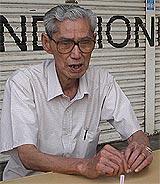
Lin Qi Hui, 80, looks like any other grandfather next door. However, his life has been extraordinary and ironical.
 The fact that the Muar-born retired octogenarian from China recently visited his hometown and paid respects to his long dead family members, friends and comrades as a private and foreign tourist is a testimony to the ironical twists and turns of regional history of the last century.
But then Lin had never been alone in his traumatic experiences: like so many hundreds of the ex-allies, ex-heroes or ex-heroines of the British Empire in the Pacific War in Malaya, Lin was later hunted down, arrested, detained, tortured and prosecuted as a 'terrorist' and banished to China by the returned colonialists after the war had ended.
"I was a man wanted and hunted not only by the Japanese fascists during the war, but also British colonial authorities after the war had ended and, upon my arrival at southern China in August 1949 as the result of British banishment, the Kuomintang (China's Nationalist Party) regime," he said when met by this writer in the house of his relatives in Petaling Jaya.
Lin Qi Hui, 80, looks like any other grandfather next door. However, his life has been extraordinary and ironical.
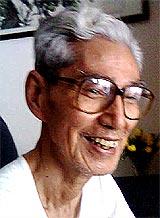 The fact that the Muar-born retired octogenarian from China recently visited his hometown and paid respects to his long dead family members, friends and comrades as a private and foreign tourist is a testimony to the ironical twists and turns of regional history of the last century.
But then Lin had never been alone in his traumatic experiences: like so many hundreds of the ex-allies, ex-heroes or ex-heroines of the British Empire in the Pacific War in Malaya, Lin was later hunted down, arrested, detained, tortured and prosecuted as a 'terrorist' and banished to China by the returned colonialists after the war had ended.
"I was a man wanted and hunted not only by the Japanese fascists during the war, but also British colonial authorities after the war had ended and, upon my arrival at southern China in August 1949 as the result of British banishment, the Kuomintang (China's Nationalist Party) regime," he said when met by this writer in the house of his relatives in Petaling Jaya.
In August 1949, southern China was still governed by the Kuomintang regime although the northern parts had already been taken over by the communist People's Liberation Army in the 1946-1949 Chinese Civil War.
"But before I pass on, I would like it to be publicly known that Dato' Onn Jaafar was a good man, a man of integrity; he was not anti-Chinese," Lin suddenly switched the topic of our conversation.
"All these years, I have heard so many unfounded accusations against him but I know him, met him four times in his house and we worked together to promote inter-racial peace in the immediate post-war months," he added.
Loved all races
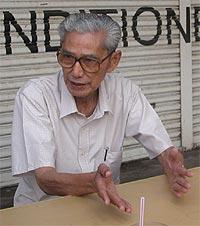 "Yes, he worked as a government official during the Japanese occupation, but he never harmed the communists or the resistance movement; yes, he was a Malay nationalist but he was never anti-Chinese," Lin continued in an emotional voice.
"As a Malay, it was only natural for Dato' Onn to love his ethnic community but he equally loved the Chinese and Indians; in fact, I once heard him telling the Malays that, Chinese and Indians had contributed tremendously to the economic development of Malaya which also benefited the Malays and the British were only interested in exploiting the natural resources of Malaya," he recalled.
Lin then turned to philosophising: "We can and must love our own ethnic communities but loving one's own race does not mean we must hate other communities".
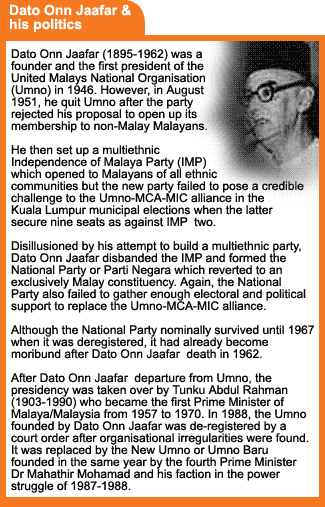 Asked why he suddenly changed the topic of conversation to Onn Jaafar and why he was so passionate in defending the founding father of the 1946 United Malays National Organisation (Umno), Lin simply replied: "Because he was a good man, a man of peace, a man of integrity".
"When the Malay-Chinese inter-communal riots broke out and persisted in the vicinity of Muar in the wake of the Japanese surrender, it was Dato' Onn who worked with us to restore peace," Lin said.
"I personally went to his house four times to brief him on the situations, discuss solutions with him and asked him to join a peace-making committee; we went to invite him to help because we knew he was respected by the Malays and also he was not anti-communist or anti-Chinese," he said.
At that time, Onn Jaafar was the district officer of Muar.
Instigation and provocation
According to Lin, the Communist Party of Malaya (CPM) also sent RG Balan to Johor to help him to stabilise the situations and find solutions to the inter-communal conflicts.
"Comrade Balan came from Perak; he was a reticent man who preferred to listen to what other had to say first before he said anything; he always looked serious and reflective; well, he spoke good English".
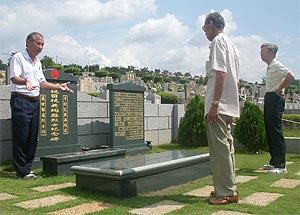 Asked why the post-war inter-communal conflicts broke out, Lin first attributed the "major cause" to the "instigation and provocation" of some defeated Japanese soldiers who refused to accept the reality of being defeated.
"They made use of their local agents like one Haji Salleh to stir things up by spreading rumours like Chinese were going to take over Malaya from the Malays; of course, there were also Chinese gangsters and bandits who tried to fish in troubled waters
"As for us the communists, although we had long been trained and instructed to build an inter-communal united front to foster unity among the people, many of us were young, socially inexperienced, not very well educated, hot-headed and simply too busy to handle the post-war situations well enough; we did make mistakes and errors in the chaotic aftermath of the war," he said.
"The war ended unexpectedly and when we came out from our jungle camps, there were so many things to be done and so many people expected us to do something for them like providing food and jobs for them; some even asked us to settle husband/wife disputes; we also had to ensure that the Japanese soldiers who surrendered did not cause trouble to the population; I was only 20 and many of the comrades were also only in their early twenties," Lin continued.
Help from Malay leaders
"At first, we were so busy in the town that we did not even know racial riots had broken out in the outskirts; it was only after Comrade Kassim who saw what happened informed us that we realised that the situation was grave."
According to Lin, Kassim was a communist of Javanese origin.
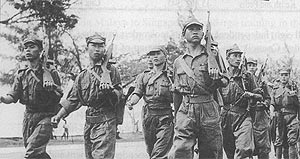 "So, we sent out some MPAJA comrades to the troubled areas to try and restore order by showing our strength and hoping to overawe the rioters with our military bands, but the sentiments on both sides of the racial divides had been so seriously inflamed that we were blamed by both sides," he said.
"On one hand, the Malays saw us as pro-Chinese because most of us were Chinese; on the other hand, the private Chinese vigilantes and gangsters thought we were pro-Malay because we tried to stop them from continuing to take what they considered to be defensive actions; the Chinese vigilantes were, in particular, very undisciplined ," Lin lamented.
"Worse still, some Malays mistakenly thought that all armed Chinese were communists or MPAJA personnel," he added with a sigh.
 "Fortunately, respected Malay and Muslim leaders like Dato' Onn and Haji Ghani finally decided to help and to work with us to form a multi-ethnic peace-making committee; with Comrade Balan also joining in the effort, the situations turned better," he said.
According to Lin, Haji Ghani was a highly respected community leader among the Muslims and during the occupation, he was considered to be sympathetic to the communists and MPAJA.
Finally, according to Lin, the committee wrote a letter to Haji Salleh, the man who was thought to be the "mastermind" of the tensions and conflicts, asking him to sign a cease-fire agreement. That, according to Lin, was accepted by Salleh.
Tomorrow: From schoolboy to freedom fighter, 'terrorist' & judge


